


How Long a Cat Pheromone Diffuser Takes to Work
A pheromone diffuser reaches full output within about 24 hours of being plugged in, but that is the device warming up, not the cat responding. The largest placebo-controlled trial detected a measurable difference at day 7, and the honest assessment window is a full month of continuous use. Anything described as working overnight is describing the device. Pawganix CalmGuard uses the F3 facial pheromone, the same fraction used in the trials below.
Most of the disappointment with pheromone diffusers comes from a mismatch in timing. People plug one in on a Friday because something is going wrong, check on Saturday, and see a cat behaving exactly as it did on Thursday. The product has not failed at that point. It has barely started.
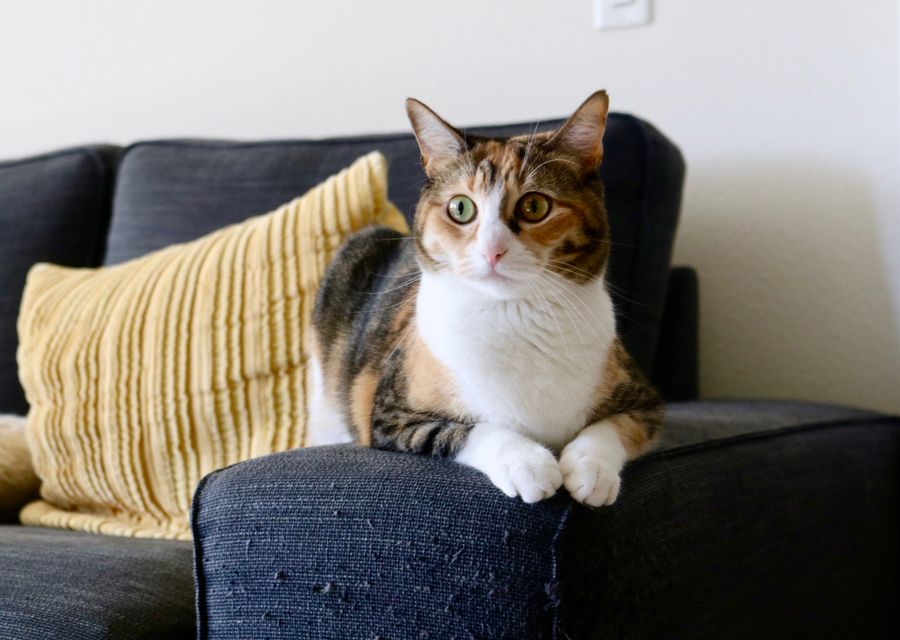
What you are watching for is a shift in baseline over weeks, not a visible reaction on the day.
Two different clocks
The device is ready in a day. The cat is not on the same schedule.
A plug-in diffuser works by gently heating a solution so it vaporises into the room. That physical process is quick, and manufacturers put it at roughly 24 hours to reach full output in a typical room. If you are preparing for something you know is coming, such as houseguests or a change to the household, plugging in two or three days ahead is sensible.
The second clock is the one that matters, and it is slower. What a facial pheromone does is change the information available in a space. A cat then has to spend time in that space, repeatedly, and gradually treat it differently. That is a behavioural process measured in weeks, and no amount of device output speeds it up.
What to expect, week by week
What the trials actually found
The largest placebo-controlled trial detected a difference at day 7, and the effect strengthened through day 28.
A triple-blind, placebo-controlled study of 1,060 caregiver and cat pairs ran for 28 days, tracking scratching behaviour. It is the most rigorous design in this field by some distance, and the timing it produced is the most useful thing in it. Statistically significant separation from placebo appeared at day 7, again at day 14, and most strongly at day 28.
That shape matters more than any single figure. The effect was smallest at the first measurement and largest at the last, which is the opposite of how people usually assess these products. Most Cat Parents decide within the first week, at exactly the point the trial found the weakest signal.
One other finding worth carrying: the comparison group improved too. Cat Parents who are actively doing something also pay closer attention, adjust routines and notice more. A diffuser works best as part of that rather than instead of it.
It will not suit every cat
Pheromones help some cats and not others, and the honest framing is support rather than solution.
Cats vary, households vary, and the underlying cause varies. A cat reacting to something specific and ongoing, such as a neighbourhood cat at the window every night or a litter tray in the wrong place, is responding to a cause that is still running. Every professional guideline positions pheromone support as one part of a plan alongside environmental change, not a standalone fix, and that is the fairest expectation to set before you start.
It also means a month of use that changes nothing is useful information rather than wasted money. It points you at the cause instead.
Not all cat pheromone products contain the same thing. CalmGuard uses F3, the synthetic version of the facial marker a cat deposits when it rubs its cheek on furniture, which is the fraction studied in all the trials above. Some competing products use a different pheromone, CAP, developed for inter-cat tension specifically. They are not interchangeable, and a study of one is not evidence for the other.
F3, the Fraction the Research Used
CalmGuard is a plug-in diffuser using the F3 feline facial pheromone, made for Cat Parents supporting a calmer home environment. Give it a full month of continuous use before you judge it.
Shop NowHow to judge it fairly
Write down the specific behaviour and roughly how often it happens, before you plug anything in.
This sounds fussy and it is the single thing that most improves your ability to tell. Gradual change is genuinely hard to perceive from inside a household, in both directions: people miss real improvement, and people also convince themselves of improvement that has not happened.
- Pick one behaviour, not a mood. "Scratched the sofa arm" is countable. "Seems happier" is not.
- Count for a week first. A rough tally on your phone is enough. Four incidents this week is a baseline you can compare against.
- Change one thing at a time. If you add a diffuser, a new scratching post and a second litter tray in the same week, you will never know which helped.
- Check at four weeks, not four days. Compare your tally against the original one rather than against your impression.
When to conclude it is not working
After a full month of continuous, correctly placed use with no measurable change in the behaviour you were tracking.
Before concluding that, three things are worth ruling out, because each of them produces the same apparent result.
Placement. A diffuser behind a sofa, under a shelf, near a vent or in a room your cat rarely uses will underperform regardless of what is in it. This is the most common fixable cause, and it is worth checking where yours is actually plugged in before giving up on it.
An unaddressed trigger. If a cat outside is visiting the window every night, or a litter tray is in a busy hallway, a pheromone is working against a cause that is still running. Every credible guideline positions pheromones as an adjunct to environmental change rather than a replacement for it.
A medical cause. This is the important one. Sudden changes in toileting, grooming, appetite or temperament can have medical explanations, and some of them are urgent. A cat straining to urinate needs a vet the same day. If the behaviour is new, sudden or escalating, that comes first and the diffuser is a side issue.
Frequently Asked Questions
The device reaches full output within about 24 hours. The behavioural response is slower: the largest placebo-controlled trial detected a measurable difference at day 7, with the strongest effect at day 28. Plan on a full month of continuous use before judging it. If you are preparing for a known event, plug it in two to three days ahead.
Usually not, and expecting to is the most common reason Cat Parents conclude a diffuser has failed. The first fortnight tends to produce subtle changes at most, such as slightly less hiding or a smaller reaction to household noise. The clearer differences, where they happen, tend to appear in weeks two to three.
No, and any source telling you otherwise is overselling. Response varies between cats and between households, and the clearest results come when a diffuser is paired with environmental changes rather than used on its own. If a full month changes nothing, that usually points to a specific cause worth identifying instead.
The pheromone itself does not stop working, but the refill empties. A refill lasts roughly 30 days of continuous use and should be replaced on that schedule even if liquid appears to remain, since the concentration falls before the vial looks empty. A gradual return of a behaviour around the four-week mark is more often an expiring refill than a cat that has adapted.
For a known upcoming event, plugging in two to three days ahead is reasonable. For an ongoing situation, intermittent use works against how the product functions: the effect builds over weeks of continuous presence, so unplugging and replugging restarts that. If cost is the reason, one diffuser in the right room used continuously will do more than two used occasionally.
Treat that as unrelated until proven otherwise and look for what else changed in the same window, since a diffuser is often bought precisely because something was already shifting. If the behaviour is new, sudden or escalating, particularly anything involving toileting, appetite or grooming, book a vet appointment rather than waiting out the month. Straining to urinate is an emergency.
Not sure what your cat actually needs?
Take the free Calm Home Audit. Ten quick questions about your cat and your home, and you get the pattern named, the four things behind it, and how many rooms need covering. No email needed to see your result.
Take the Calm Home Audit →You're already making the content. Get paid for it.
Commission on your link, or a flat fee per post. Your call. A real person reads every application and replies within two working days.
Apply in two minutesSources
- Pereira JS, et al. Improving the well-being of cats and their caregivers with a feline pheromone: a randomised, triple-blind, placebo-controlled study. PLOS ONE 2023;18(10):e0292188. Funded by Ceva Santé Animale; several authors are Ceva employees. doi.org
- Chadwin RM, Bain MJ, Kass PH. Effect of a synthetic feline facial pheromone product on stress scores and incidence of upper respiratory tract infection in shelter cats. JAVMA 2017;251(4):413-420. escholarship.org
- Frank D, Beauchamp G, Palestrini C. Systematic review of the use of pheromones for treatment of undesirable behavior in cats and dogs. JAVMA 2010;236(12):1308-1316. pubmed.ncbi.nlm.nih.gov
- Crump E. Effectiveness of F3 feline facial pheromone analogue for acute stress reduction within clinical veterinary practice. Veterinary Evidence 2023;8(4). doi.org
- Van Vertloo LR, et al. Effects of waiting room and feline facial pheromone experience on blood pressure in cats. Frontiers in Veterinary Science 2021;8:640751. doi.org
- Taylor S, St Denis K, Collins S, et al. 2022 ISFM/AAFP cat friendly veterinary environment guidelines. J Feline Med Surg 2022;24(11):1133-1163. doi.org
What is unsettling your cat?
Ten questions about your cat and your home. You get the pattern named, the four things behind it, how many rooms need covering, and a 30-day check-in date.
- 1The pattern, named, and the four things behind it
- 2How many rooms and floors need covering
- 3A plan sized to your home, and when the collar earns its place
Most read
-
 CatsMulti-Cat Household Stress: Why Your Cats Fight and How Pheromones Can Help8 min read
-
 CatsCat Vomiting: Hairballs or Gut Problem?6 min read
-
 CatsSeparation Anxiety in Cats7 min read
-
 CatsCat Calming Collars, Diffusers & Sprays7 min read
-
 CatsFeliway vs Pawganix: Cat Calming Compared7 min read
-
 CatsCat Anxiety: The Complete Guide to Causes, Symptoms, and Solutions9 min read


