


The Feline Stress Ladder: Subtle to Serious
Feline stress tends to move through a recognisable sequence, starting with subtle body language changes, then avoidance behaviours like hiding, then more visible signals like vocalisation or changes in litter box use, and finally the most obvious responses like growling, swatting, or spraying. The higher a cat climbs this ladder, the harder the underlying stress usually is to address, which is why noticing the lower rungs matters so much.
Understanding that feline stress unfolds as a sequence, not a single event, changes how Cat Parents interpret what they are seeing. A cat at the bottom of the ladder and a cat at the top are showing the same underlying stress, just at very different stages.

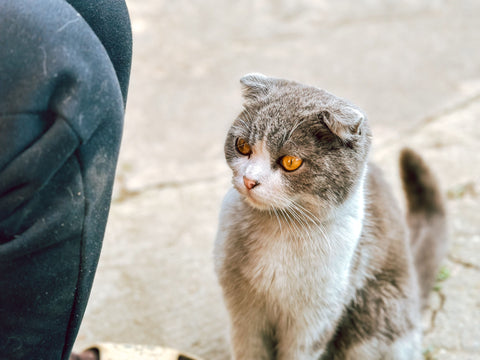
A settled, low-stress baseline is what every rung of the ladder is measured against.
The Full Ladder, Rung by Rung
Subtle body language shifts
Ears turning sideways, a slightly lower or tighter posture, a stiff tail, and reduced slow blinking. These are the quietest signals and the easiest to miss entirely.
Increased avoidance
More time spent hiding, reduced interest in play or food, and a more rigid routine as the cat tries to reduce uncertainty in the environment.
Vocal and elimination changes
Increased meowing or yowling, and the first appearance of litter box avoidance or marking behaviour, as the stress response starts affecting more visible systems.
Overt defensive or aggressive behaviour
Growling, hissing, swatting, or biting. These are the signals most Cat Parents recognise immediately, but they are the top of the ladder, not the start of the response.
Some cats show a fast escalation through the ladder in response to a strong single trigger. Others sit at rung one or two for extended periods without ever reaching overt aggression. The ladder describes a general progression, not a fixed timeline every cat follows identically.
Why the Order Matters
Most Cat Parents first notice a stress problem at rung three or four, when the behaviour is loud, visible, or disruptive to the household. By this point, the cat has typically been signalling discomfort for some time through the earlier, quieter rungs. Recognising stress at rung one, rather than waiting for rung four, gives a Cat Parent far more room to respond before the situation becomes harder to manage.
Helping a Cat Come Back Down the Ladder
A cat who has climbed to the higher rungs can generally move back down as the underlying stressor is identified and addressed, though this typically happens gradually rather than immediately. Identifying and reducing the specific trigger, providing consistent routine, and creating a calm, settled environment are the foundational steps most behaviourists recommend, regardless of which rung a cat is currently on.
Frequently Asked Questions
Stress generally progresses through subtle body language changes (ears, posture, tail), increased avoidance and hiding, vocal and litter box changes, and finally overt defensive behaviour like growling or swatting. Not every cat progresses through every stage identically.
Hiding is a natural avoidance response that gives a cat a sense of control and safety when the environment feels uncertain. It typically appears as a mid-stage signal, after subtle body language changes and before more overt behaviours.
Yes, generally. A cat who has escalated up the stress ladder can typically return to a calmer baseline once the underlying trigger is identified and addressed, along with a consistent routine and settled environment, though this usually happens gradually rather than immediately.
Restore the Peace
Pawganix CalmGuard: diffuser, 3 refills, and a bonus calming collar. Soothes the stress behind unwanted behavior.
Shop NowNot Sure What Your Cat Needs?
Take the free Calm Home Audit. Ten quick questions about your cat and your home, and you get the pattern named, the four things behind it, and how many rooms need covering. No email needed to see your result.
Take the Calm Home Audit →This content is for informational purposes only and is not a substitute for professional veterinary or behavioural advice. If your cat shows sudden or significant behaviour changes, consult your veterinarian to rule out an underlying medical cause.
What is unsettling your cat?
Ten questions about your cat and your home. You get the pattern named, the four things behind it, how many rooms need covering, and a 30-day check-in date.
- 1The pattern, named, and the four things behind it
- 2How many rooms and floors need covering
- 3A plan sized to your home, and when the collar earns its place
Most read
-
 CatsMulti-Cat Household Stress: Why Your Cats Fight and How Pheromones Can Help8 min read
-
 CatsCat Vomiting: Hairballs or Gut Problem?6 min read
-
 CatsSeparation Anxiety in Cats7 min read
-
 CatsCat Calming Collars, Diffusers & Sprays7 min read
-
 CatsFeliway vs Pawganix: Cat Calming Compared7 min read
-
 CatsCat Anxiety: The Complete Guide to Causes, Symptoms, and Solutions9 min read


