


Where to Place a Cat Pheromone Diffuser
Plug it into an open wall socket in the room your cat actually spends the most time in, at normal socket height, with clear air above it and nothing within about four feet overhead. Not behind furniture, not in a hallway, not near a vent or an air conditioner, and never in an extension lead or multi-plug adapter. Placement is the most common fixable reason a diffuser underperforms, and correcting it costs nothing. Pawganix CalmGuard plugs in the same way.
A pheromone diffuser is one of the few products where the instructions genuinely change the outcome. It disperses into the air in the room it occupies and nowhere else, so the socket you pick decides most of what happens next.
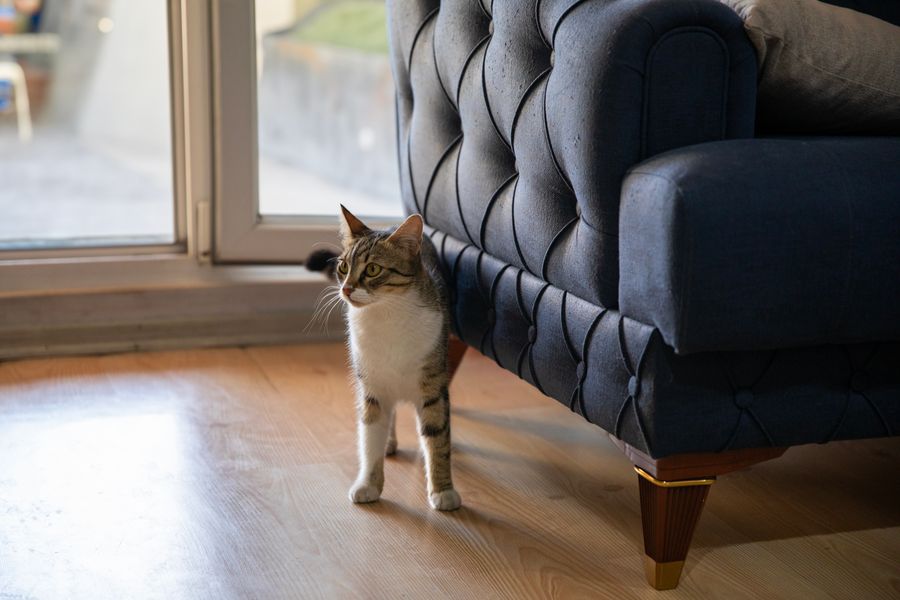
Pick the room by where your cat chooses to be, not by where the problem is most annoying to you.
The figures below reflect published guidance for plug-in pheromone diffusers as a category. Units differ, so follow the instructions that came with your own product for its specific coverage area and refill schedule.
Which room
The room your cat spends the most time in, or the room where the behaviour is actually happening.
Those two are usually the same room, and when they are not, follow the cat. A diffuser in a room your cat passes through twice a day is doing very little, however central that room feels to you.
Work out where your cat actually is. Not where their bed is, which is often a piece of furniture bought with more hope than accuracy. Where do they sleep during the day, where do they sit when the household is quiet, and where do they go when someone rings the doorbell. That room is the one.
Hallways are the classic mistake. They feel like a sensible central point from which everything radiates, and they are almost the worst choice: cats do not spend meaningful time in them, and the air moves constantly. The only exception is a hallway that is itself the site of the marking.
Litter trays are the second mistake, usually made with good intentions. A cat spends a few minutes a day there. Put the diffuser where they rest, and solve litter tray problems with the tray setup itself.
Height and clearance
A normal wall socket at skirting height is correct. What matters is the space above it.
You do not need to mount it high. Vaporised pheromone rises and disperses on its own, and the published guidance asks for a minimum of about 1.2 metres, roughly 4 feet, of clear space above the diffuser. An ordinary low socket on an open wall gives you that easily.
What defeats it is anything forming a lid. A socket under a shelf, behind a sofa back, under a side table or beneath a worktop traps the output in a pocket of still air a few inches deep. The device runs, the refill empties on schedule, and almost nothing reaches the room.
Keep it plugged in the right way up, and leave it plugged in continuously. The effect is built on sustained presence, so unplugging it overnight or while you are out works against how it functions.
Where not to put it
The extension lead point is the one people ignore most often, because a free wall socket is rarely where you want it. Use a different wall socket instead, even if it means a less ideal room. The manufacturer instruction is explicit that these go into a standard wall outlet only.
How many you need
One unit covers roughly 700 square feet of open-plan space, and it does not travel between floors.
The published coverage figure is up to 70 square metres, which appears as 750 square feet on some regional sites and 700 square feet on others, including the US label. Use whichever matches your market, and treat any single global number with suspicion.
Coverage assumes open, connected air. It is not a radius that passes through closed doors, and it does not go up or down stairs. The manufacturer's own guidance is that in a multi-level home, one unit per level is likely to be more appropriate, particularly in a multi-cat household.
| Situation | Sensible starting point |
|---|---|
| Studio or one-floor flat, open plan | One, in the main living space |
| Two-storey house, one cat who roams | One per floor the cat uses |
| Multi-cat household over several floors | One per level, prioritising where the cats rest and where tension occurs |
| One cat confined to one room during a settling-in period | One, in that room |
Most single-floor homes with one cat need one diffuser in the right place rather than two in the wrong ones. Fix placement before adding units.
Plug It In Where Your Cat Actually Lives
CalmGuard is a plug-in diffuser using the F3 feline facial pheromone, made for Cat Parents supporting a calmer home. Follow the instructions in the pack for your unit's own coverage and refill schedule.
Shop NowWhen to replace it
The refill runs about 30 days. The unit itself has a shorter working life than most people assume.
Two separate schedules, and confusing them is a common cause of a diffuser that seems to stop helping.
- Refills: roughly 30 days of continuous use. Replace on that schedule even if liquid is still visible, because the concentration drops off before the vial looks empty. A behaviour creeping back at around four weeks is more often an ageing refill than a cat that has adapted.
- The diffuser unit: the published guidance is to replace the device itself every six months, or every six refills. The heating element degrades, so an old unit with a fresh refill does not deliver what a new one does.
If you want one habit to carry away: write the date on the refill in marker when you fit it.
Safety, stated plainly
Safe as a plugged-in device used as directed. The liquid concentrate inside is a different matter and should be treated like any household refill.
Keep the vial out of reach of children. If the liquid is swallowed, contact a physician immediately.
The unit runs warm. That is how it vaporises the solution, and it is normal. Do not handle it while it is operating, and give it a few minutes to cool before changing a refill.
Wall socket only. No extension leads, adapters or converters.
It is not a sedative. These products are not tranquillisers, and nothing here is a substitute for veterinary care when a cat needs it.
Other animals in the house
Feline facial pheromones are species-specific, and the manufacturer position is that they are harmless to dogs, so a cat diffuser and a dog diffuser can run in the same house. For caged birds, the published advice is to plug the unit into a different room as a precaution, because birds have unusually sensitive respiratory systems. For fish, keep it as far from the tank as practical so nothing settles on the water surface.
Frequently Asked Questions
An open wall socket in the room your cat spends the most time in, with around four feet of clear space above it. Ordinary skirting height is fine. Avoid sockets under shelves or behind furniture, anywhere near a vent or air conditioner, hallways, and beside the litter tray. Never use an extension lead or adapter.
Near where they rest is right, but do not aim it at the bed itself. What you want is good dispersal through the room they occupy, so an open socket on a clear wall in that room beats a cramped one beside the bed. If their favourite spot is behind a sofa, use a different socket in the same room rather than the nearest one.
Better not to. The effect builds over weeks of continuous presence in one space, so moving the unit restarts that in the new room and lets it fade in the old one. If two rooms genuinely both need it, that is a second unit rather than a rota. Pick the room where your cat spends the most time and leave it there.
Cat count matters less than floor plan. Two cats sharing one open-plan floor within the coverage area are served by one unit. Two cats across three floors, or two cats who keep to separate territories, need one per level or per territory. If the issue is tension between them specifically, note that some products use a different pheromone developed for that situation, so check which type you are buying.
Yes, and it is designed for exactly that. These units are intended for continuous use in a standard wall socket, and the unit running warm is normal operation rather than a fault. Replace refills roughly monthly and the unit itself around every six months, and keep it out of an extension lead.
Feline facial pheromones are species-specific and the manufacturer position is that they are harmless to dogs. For children, the relevant instruction is on the label: keep the vial out of reach, because the liquid is harmful if swallowed even though the diffused vapour used as directed is not the concern. For caged birds, the published advice is to use a different room.
Not sure what your cat actually needs?
Take the free Calm Home Audit. Ten quick questions about your cat and your home, and you get the pattern named, the four things behind it, and how many rooms need covering. No email needed to see your result.
Take the Calm Home Audit →You're already making the content. Get paid for it.
Commission on your link, or a flat fee per post. Your call. A real person reads every application and replies within two working days.
Apply in two minutesSources
- Ceva Animal Health. Feliway frequently asked questions, placement and coverage guidance. ceva.co.za and feliway.com
- Feliway Classic Diffuser refill product label, Ceva Animal Health LLC. Composition, warnings and handling instructions. drugs.com/vet
- Taylor S, St Denis K, Collins S, Dowgray N, Ellis SLH, Heath S, Rodan I, Ryan L. 2022 ISFM/AAFP cat friendly veterinary environment guidelines. J Feline Med Surg 2022;24(11):1133-1163. doi.org
- Pereira JS, et al. Improving the well-being of cats and their caregivers with a feline pheromone: a randomised, triple-blind, placebo-controlled study. PLOS ONE 2023;18(10):e0292188. Manufacturer funded. doi.org
What is unsettling your cat?
Ten questions about your cat and your home. You get the pattern named, the four things behind it, how many rooms need covering, and a 30-day check-in date.
- 1The pattern, named, and the four things behind it
- 2How many rooms and floors need covering
- 3A plan sized to your home, and when the collar earns its place
Most read
-
 CatsMulti-Cat Household Stress: Why Your Cats Fight and How Pheromones Can Help8 min read
-
 CatsCat Vomiting: Hairballs or Gut Problem?6 min read
-
 CatsSeparation Anxiety in Cats7 min read
-
 CatsCat Calming Collars, Diffusers & Sprays7 min read
-
 CatsFeliway vs Pawganix: Cat Calming Compared7 min read
-
 CatsCat Anxiety: The Complete Guide to Causes, Symptoms, and Solutions9 min read


