


The Subtle Signs of Cat Joint Pain Most Owners Miss
Cats with arthritis almost never limp, which is why the signs get filed under normal ageing. What you are more likely to see is a cat who hesitates before jumping, picks a lower perch than they used to, grooms less, or has become oddly short-tempered. Arthritis is diagnosed by a veterinarian, and the behaviour changes below are what get the conversation started.
Your cat still jumps onto the bed. They still eat, still purr, still find the sunny patch by eleven. So when someone asks whether they might be in pain, the honest answer feels like no.
The numbers say otherwise, and the gap between what is happening and what gets noticed is enormous.
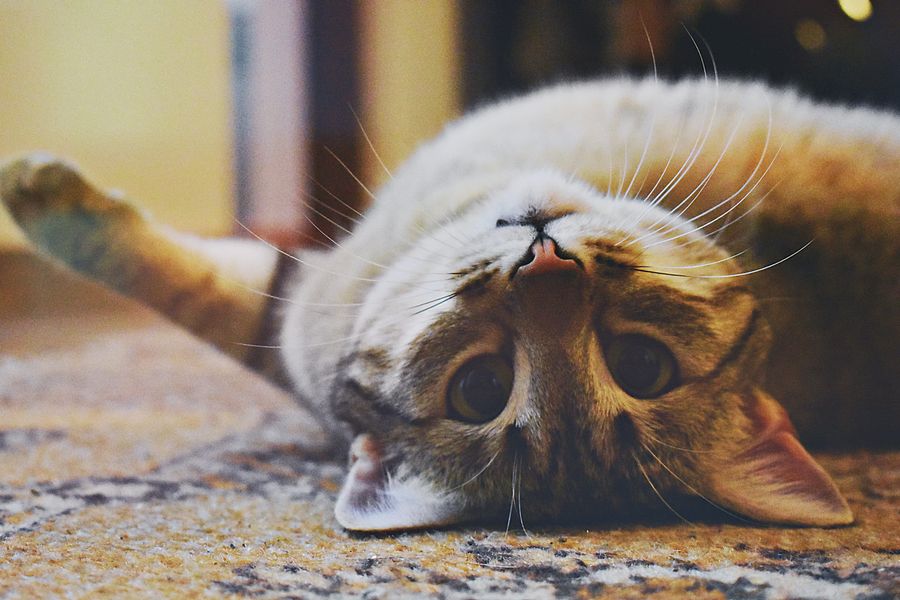
A cat who has quietly stopped using the top of the bookshelf is telling you something.
Why cat joint pain goes unnoticed
Because we are watching for the wrong thing. We look for a limp, and cats with arthritis usually do not limp.
In one body of work, around 90% of cats over 12 years old showed radiographic evidence of arthritis, while only about 4% had arthritis mentioned by either the owner or the veterinarian. A separate retrospective study of 100 cats found radiographic signs in 82% of cats over 14. The condition is common. Recognising it is not.
There are two reasons for that gap. The first is that arthritis in cats is often symmetrical, affecting the same joints on both sides, so there is no good leg to favour and therefore no visible limp. The second is that cats are exceptionally good at concealing discomfort, which is sensible behaviour for a small solitary predator and deeply unhelpful for the person trying to look after one.
So the signal does not arrive as a limp. It arrives as a slow change in what your cat chooses to do.
The five mistakes owners make
Waiting for a limp
The single most common one. Limping is the sign we know from dogs, and it is considerably less common in cats unless changes are advanced or there is an acute flare. A cat can have significant joint disease and walk across the room perfectly normally.
Filing it under getting old
Slowing down is treated as the natural order of things rather than as a symptom worth investigating. Age is not a diagnosis. A cat who sleeps more and plays less at 13 may simply be 13, or may be sore, and the only way to tell is to ask a vet.
Missing the change because it was gradual
Joint changes build over years. The cat who once landed on the kitchen counter in one go now uses the chair first, and because that shift happened over eighteen months, nobody registers it as a change at all. Old photos and videos are more reliable than memory here.
Reading behaviour changes as personality
A cat who has become withdrawn, or who now objects to being picked up, gets described as having got grumpy in old age. A cat in discomfort may well react to handling that used to be fine, and that is information rather than a character flaw.
Assuming a quiet cat is a comfortable cat
Vocalising is sometimes listed as a sign, which leads owners to conclude that a silent cat must be fine. Plenty of sore cats say nothing at all. Absence of complaint is not evidence of comfort.
What to actually watch for
Watch what your cat has quietly stopped doing.
| Area | What a change can look like |
|---|---|
| Jumping | Hesitating before a jump, breaking one jump into two, choosing a lower surface, or no longer going to a favourite high spot at all |
| Grooming | A scruffier coat, or matting over the back and hips where twisting has become uncomfortable. Sometimes the opposite: overgrooming one joint |
| Litter box | Accidents just outside the tray, or reluctance with a high-sided box or one that needs stairs to reach |
| Sleep and rest | More sleeping, different resting places, or shifting position often because no position stays comfortable |
| Handling | Objecting to being lifted, brushed or touched over the hips and lower back when that was previously fine |
| Play and social life | Shorter play sessions, less interest in the things that used to reliably work, or withdrawing from the household |
Film your cat jumping onto their usual spots, walking away from the camera, and getting in and out of the litter tray. Vets see a frightened cat on a metal table who is masking hard. Thirty seconds of footage from home is often far more useful than anything that happens in the consulting room.
Pain or stress? They look alike
Hiding, reduced grooming, litter box changes and irritability appear on the list for joint pain and on the list for stress. That overlap is exactly why guessing is a bad idea.
A Cat Parent who decides the problem is stress may spend months on enrichment and routine while a sore cat goes untreated. A Cat Parent who decides the problem is pain may miss a household change that upset their cat. The two also feed each other: a cat who finds their favourite perch painful to reach loses a resource they relied on, and losing resources is itself stressful.
The order matters. A veterinary assessment comes first, because pain needs veterinary management and nothing you do at home substitutes for that. Once pain has been ruled out or is being managed, the environmental side is worth working on, and our complete guide to cat anxiety covers what that looks like.
What helps at home
None of this replaces veterinary care, and a cat suspected of joint pain needs a vet rather than a home adjustment. Alongside that, small changes to the environment remove the daily obstacles:
- Add a step. A stool or low box next to a favourite perch turns one hard jump into two easy ones and gives back a spot they had written off.
- Swap the litter tray. A lower entry, or a tray on the same floor the cat spends most time on, removes a climb from an already uncomfortable routine.
- Raise the food and water. A slightly elevated bowl means less crouching.
- Warm, supported resting places. Soft bedding somewhere draught-free and easy to reach without climbing.
- Keep them lean. Extra weight loads every joint on every step, and this is the one you control directly. Ask your vet to show you a body condition score on your own cat.
If It Turns Out to Be Stress, Not Pain
Pain is a veterinary matter first. Where your vet has ruled it out and the picture looks like stress instead, CalmGuard is an F3 pheromone diffuser that soothes the unsettled behaviour behind hiding, scratching and marking.
Shop NowFrequently Asked Questions
Usually not. Arthritis in cats often affects the same joints on both sides, so there is no sound leg to shift weight onto and no visible limp. Limping tends to appear only when changes are advanced or during an acute flare. Waiting for a limp is the most common reason joint pain in cats goes unnoticed for years.
Earlier than most Cat Parents expect. Radiographic changes are very common in cats over 12, and are found in younger cats too. Because the signs are behavioural rather than dramatic, the start is rarely noticed at the time, which is why comparing against old photos and videos is so useful.
From the signs alone, you often cannot. Hiding, reduced grooming, litter box changes and irritability appear on both lists. That is why a veterinary assessment comes first: pain needs veterinary management, and hiding in particular has several possible explanations that are worth separating before you act on a guess.
Video from home, taken over several days. Film your cat jumping, walking away from the camera, and using the litter tray. Cats mask discomfort in a clinic, so footage of ordinary behaviour at home is often more informative than the examination itself. A written note of what has changed and roughly when also helps.
No. Pawganix currently makes joint supplements for dogs only, and there is no cat equivalent. If your vet recommends joint support for your cat, ask them for a product intended for cats rather than adapting a dog formula, since species and dosing differ.
Not Sure What Your Cat Needs?
Take the free Calm Home Audit. Ten quick questions about your cat and your home, and you get the pattern named, the four things behind it, and how many rooms need covering. No email needed to see your result.
Take the Calm Home Audit →You're already making the content. Get paid for it.
Commission on your link, or a flat fee per post. Your call. A real person reads every application and replies within two working days.
Apply in two minutesSources
- Diagnosis and Management of Feline Osteoarthritis, Today's Veterinary Practice.
- Osteoarthritis in cats: a retrospective radiological study, via PubMed.
This content is for informational purposes only and is not a substitute for professional veterinary advice. Joint pain in cats is diagnosed by a veterinarian, and the behaviour changes described here have several possible causes including illness unrelated to joints. Never give your cat a medication or supplement intended for dogs or people, and never give pain relief without veterinary direction, since several common human painkillers are toxic to cats.
Most read
-
 CatsMulti-Cat Household Stress: Why Your Cats Fight and How Pheromones Can Help8 min read
-
 CatsCat Vomiting: Hairballs or Gut Problem?6 min read
-
 CatsSeparation Anxiety in Cats7 min read
-
 CatsCat Calming Collars, Diffusers & Sprays7 min read
-
 CatsFeliway vs Pawganix: Cat Calming Compared7 min read
-
 CatsCat Anxiety: The Complete Guide to Causes, Symptoms, and Solutions9 min read


