


Cat Carrier and Vet Visit Anxiety: What Helps
The carrier is the problem, not the clinic. Most cats only ever see it before something unpleasant, so it becomes the warning rather than the transport. The fix with actual measured evidence behind it is leaving the carrier out permanently as ordinary furniture and training your cat to walk into it voluntarily, which in one trial measurably reduced transport stress and made the examination itself shorter. A settled home helps too, and Pawganix CalmGuard supports the room your cat leaves from and comes back to.
There is a specific sound a cat makes when it sees the carrier come out of the cupboard, and most Cat Parents can do an impression of it. That reaction is learned, it is reasonable from the cat's point of view, and it is the main reason cats get less veterinary care than dogs.
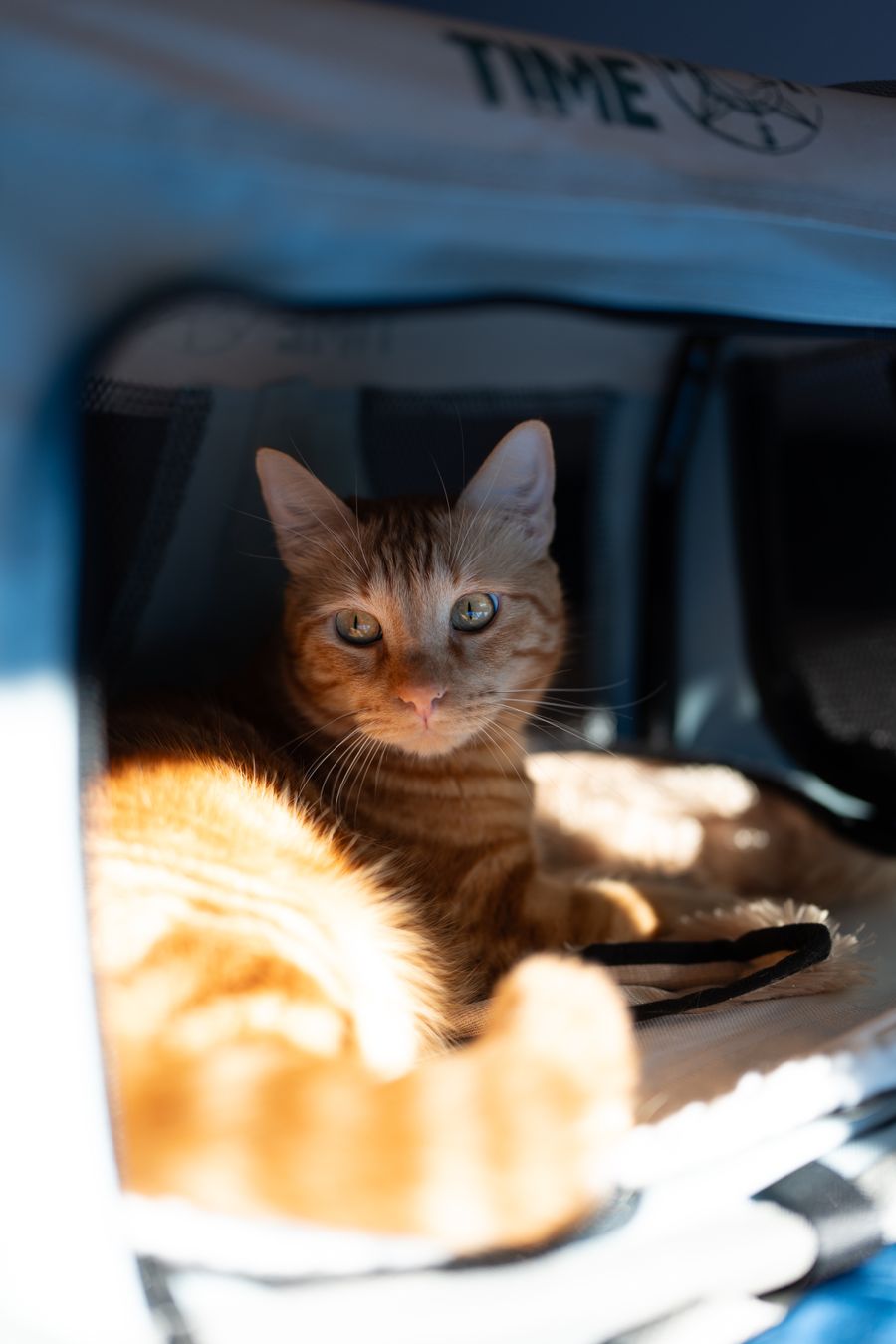
The goal is a carrier your cat chooses to nap in, which takes weeks rather than minutes.
Why this matters more than it sounds
Cats receive roughly half the veterinary care dogs do, and transport is repeatedly identified as the main obstacle.
The gap is not small. National figures put average annual veterinary visits at 1.5 per dog against 0.7 per cat. In the same data, 82.8% of dog-owning households made at least one veterinary visit in a year, against 54.3% of cat-owning households. For routine preventive care the split was 78.8% against 47.2%.
A large owner survey put more detail on it: 52% of US cats had not been to a vet in the past year, 58% of cats were described by their owners as disliking the clinic, and 38% of owners said that simply thinking about the visit was stressful. A companion survey of veterinary practices identified carrier use and transportation as the number one obstacle.
That last point is the useful one. The barrier is not the examination or the cost or the clinic. It is the twenty minutes before leaving the house, and that part is fixable at home.
Choosing the carrier
A carrier with a removable top, or failing that a front opening. The top matters because of how the cat comes out at the other end.
Current professional guidelines recommend carriers with removable tops as the preferred design, and front-opening where the top cannot be removed. The reason is what happens in the consulting room. With a removable top, the top comes off and your cat is examined sitting in the familiar base on their own bedding, never having been pulled out of anything. Where a cat cannot be tipped or lifted out easily, the guidance is to slide them out on their bedding rather than reaching in and dragging them.
Stop putting the carrier away. A carrier that lives in a cupboard and appears twice a year is a reliable predictor of something unpleasant, and your cat has learned that correctly. A carrier that sits open in the corner of the living room with a blanket in it is furniture, and furniture is not frightening.
This costs nothing, and it is the foundation everything else in this article is built on.
The six weeks that changed the numbers
A carrier training programme reduced measured transport stress and made the veterinary examination itself around 42 seconds shorter.
This is the best evidence available on the subject. Twenty-two cats were split into two groups. One group went through 28 short positive-reinforcement training sessions over six weeks, teaching them to walk into the carrier voluntarily. The other group had no training. Both were then filmed during a ten-minute car journey and assessed at the clinic.
| Measure | Result for the trained group |
|---|---|
| Cat Stress Score during transport | Significantly greater reduction than controls |
| Ear temperature, a physiological stress marker | Significantly lower |
| Length of the veterinary examination | About 42 seconds shorter |
It is a small study, but the effect showed up on a behavioural score, a physiological measure and a stopwatch alike, and the intervention costs nothing.
What the training actually looks like
Make it furniture
Carrier out, door off or fixed open, in a room your cat uses. Put in bedding that already smells of them rather than something new from a packet. Then leave it alone for a week and do nothing else.
Pay for proximity, not entry
Drop a treat near the carrier, then at the entrance, then just inside. Your cat sets the pace. If they will not go in, the treat was too far in, not the cat too stubborn.
Feed inside it
Move a regular meal to the carrier, door open. Short and routine beats long and special. This is the step that does most of the work, and it is worth a fortnight on its own.
Close the door for seconds
Shut it, count to three, open it, treat. Build up slowly. If your cat vocalises or scrabbles, you have gone too fast, so drop back to a duration they were comfortable with and stay there longer.
Lift, then drive
Pick the carrier up and put it down again. Later, carry it to the car. Later still, sit in the car with the engine off, then drive to the end of the road and come home. A journey that ends back at home teaches something different from a journey that ends at the vet.
Little and often is the shape of it. The trial used 28 sessions across six weeks, which is roughly five a week, each only a few minutes.
On the day
- Prepare the carrier and car about 15 minutes ahead, which is the timing the professional guidelines specify for pheromone spray, and also gives any alcohol carrier time to evaporate before your cat goes in. Never spray directly onto a cat.
- Keep the carrier covered and stable during transport. A towel over most of it, leaving airflow, is the standard recommendation.
- Carry it with two hands, supporting top and bottom, held close to your body. Never by the handle or shoulder strap alone. A swinging carrier is a small earthquake from inside.
- In the car, most carriers belong on the floor behind the front seats, which is the guidance for hard-sided plastic carriers in particular. Some crash-tested models can be belted into the back seat.
- At the clinic, ask for the carrier to go on an elevated surface rather than the floor, and keep it away from dogs at nose height.
One more, and it makes a genuine difference: tell the practice when you book that your cat finds visits difficult. Many clinics will offer a quieter appointment slot or a separate waiting area, and the professional guidelines explicitly ask them to.
What pheromones do and do not do here
There is real but partial evidence for a pheromone spray used inside the carrier. It is not a substitute for the training above.
A randomised, blinded, placebo-controlled pilot in 150 cats sprayed 2 to 3 mL into the carrier 15 minutes before the cat went in, and assessed them half an hour into the journey. It found significant reductions against placebo in curling, motionlessness and meowing. Read carefully, that is three of ten measured behaviours, and it was a pilot study.
The wider appraisals land in the same place: pheromone support works best incorporated alongside cat-friendly handling and the training above, rather than used on its own.
That carrier research tested a spray, applied inside the carrier beforehand. A plug-in diffuser is a room product and belongs somewhere else in this picture: the space your cat leaves from and comes back to. A cat who is settled at home starts the journey from a calmer baseline, and returns to a room that has not changed while they were out.
The Room They Leave From, and Come Back To
CalmGuard is a plug-in diffuser using the F3 feline facial pheromone, made for Cat Parents supporting a calmer home environment. Plug it in where your cat rests, and give it a full month of continuous use.
Shop NowComing home
Open the carrier in a quiet room and let your cat come out when they choose.
Do not tip them out, and do not follow them to check on them. Most cats want somewhere dark and elevated for an hour or two, and giving them that is the fastest route back to normal.
In a multi-cat home there is a specific thing to watch for. A cat returning from the vet smells of the clinic, and the others may react to them as a stranger, sometimes with real hostility. This catches people out because the two cats were fine that morning. Keeping the returning cat separate for a few hours, so the unfamiliar scent fades before they are reintroduced, usually avoids it altogether. If tension does flare, separate them rather than intervening physically and let it settle.
Frequently Asked Questions
On the day, the answer is a top-opening carrier, a towel, and calm speed: wrap loosely and lower them in from above rather than pushing them through a front door. For the longer term, the reason they run is that the carrier only ever appears before something unpleasant. Leaving it out permanently and feeding them in it breaks that association, and that is the change with measured evidence behind it.
Yes. The professional guidelines recommend keeping the carrier covered and stable during transport, and most cats settle better with less visual input. Leave airflow, and if your cat's body language says they would rather see out, follow your cat.
Ask the practice rather than deciding yourself, because it depends entirely on what is planned. Fasting is usually required before sedation or a general anaesthetic and often before certain blood tests, but it is unnecessary for a routine check and removes a useful tool, since a slightly hungry cat is easier to reward into the carrier. One question when you book settles it.
There are prescription options for cats who find travel genuinely distressing, and for some cats they are the right answer. That is a conversation with your vet, not something to source or dose yourself, and it works best combined with the handling and training changes here rather than instead of them. Worth raising specifically if your cat's reaction is severe enough that you have been avoiding appointments.
The trial that measured a benefit ran 28 short sessions across six weeks, so plan on about that for a routine appointment you can schedule. If the appointment is tomorrow, you cannot train for it, and the useful moves are the day-of ones: the towel, the covered carrier, two hands, and a quieter slot if the practice can offer one. Then start the training afterwards for next time.
The returning cat comes home carrying clinic scent, and cats identify each other largely by smell, so to the cat who stayed home the other one briefly reads as an intruder. It is common, it is not a sign the relationship has broken, and it usually resolves within hours. Keeping them apart until the unfamiliar scent fades is the simplest way to avoid the fight entirely.
Not sure what your cat actually needs?
Take the free Calm Home Audit. Ten quick questions about your cat and your home, and you get the pattern named, the four things behind it, and how many rooms need covering. No email needed to see your result.
Take the Calm Home Audit →You're already making the content. Get paid for it.
Commission on your link, or a flat fee per post. Your call. A real person reads every application and replies within two working days.
Apply in two minutesSources
- Pratsch L, Mohr N, Palme R, Rost J, Troxler J, Arhant C. Carrier training cats reduces stress on transport to a veterinary practice. Applied Animal Behaviour Science 2018;206:64-74. doi.org
- Rodan I, Dowgray N, Carney HC, et al. 2022 AAFP/ISFM cat friendly veterinary interaction guidelines: approach and handling techniques. J Feline Med Surg 2022;24(11):1093-1132. doi.org
- Taylor S, St Denis K, Collins S, et al. 2022 ISFM/AAFP cat friendly veterinary environment guidelines. J Feline Med Surg 2022;24(11):1133-1163. doi.org
- American Veterinary Medical Association. Pet ownership stable, veterinary care variable. JAVMA News 2019. avma.org
- Bayer Veterinary Care Usage Study, feline findings. Industry-funded owner and practice survey. catvets.com
- Shu H, Gu X. Effect of a synthetic feline facial pheromone product on stress during transport in domestic cats: a randomised controlled pilot study. J Feline Med Surg 2022;24(8):691-699. doi.org
- Van Vertloo LR, et al. Effects of waiting room and feline facial pheromone experience on blood pressure in cats. Frontiers in Veterinary Science 2021;8:640751. doi.org
- Crump E. Effectiveness of F3 feline facial pheromone analogue for acute stress reduction within clinical veterinary practice. Veterinary Evidence 2023;8(4). doi.org
- American Animal Hospital Association. Helping your cat cope with veterinary visits. aaha.org
What is unsettling your cat?
Ten questions about your cat and your home. You get the pattern named, the four things behind it, how many rooms need covering, and a 30-day check-in date.
- 1The pattern, named, and the four things behind it
- 2How many rooms and floors need covering
- 3A plan sized to your home, and when the collar earns its place
Most read
-
 CatsMulti-Cat Household Stress: Why Your Cats Fight and How Pheromones Can Help8 min read
-
 CatsCat Vomiting: Hairballs or Gut Problem?6 min read
-
 CatsSeparation Anxiety in Cats7 min read
-
 CatsCat Calming Collars, Diffusers & Sprays7 min read
-
 CatsFeliway vs Pawganix: Cat Calming Compared7 min read
-
 CatsCat Anxiety: The Complete Guide to Causes, Symptoms, and Solutions9 min read


