

Ever wonder why your breed is always a little itchy?
It's rarely random — and it's rarely their fault. Some of America's most-loved breeds are born with skin, coats, ears, and folds that quietly create a yeast-friendly home. YeastGuard supports normal yeast balance from the inside out — dosed by weight, so one bottle fits every one of them.

Is your breed one of the itchiest?
Scroll to your dog below and see why the itch keeps circling back — and what actually helps from the inside out. Vet-reviewed formula · 12 disclosed actives · weight-based dosing · 60-day happiness guarantee.
You've written it off as 'just how the breed is.'
The Frenchie that's always chewing a paw. The Lab whose ears smell a day after the lake. The Westie whose bright white coat keeps going dull and pinkish. Ask around at the dog park and you'll hear the same shrug: that's just the breed.
Here's the honest reframe — it's not random, and it's not your dog's fault. It's anatomy: folds, floppy ears, coat oils, and allergy-prone skin that add up to a yeast-friendly home. And because it's built in, the surface fixes never quite hold.

6 breeds America loves — and the reason they share the same itch
Find your breed. Every one of these dogs is wonderful — and every one of them was born with a skin, coat, ear, or fold setup that makes it easy for everyday yeast to feel right at home. Here's the honest, research-backed reason the itch keeps circling back, and which parts of YeastGuard's inside-out formula speak to each one.

The #1 most popular breed in America for four straight years (AKC) — and one of the most fold-heavy dogs on that list. The compact, flat-faced build you love is also a moisture trap: nose-rope, lip, and facial folds hold warmth and damp in permanent skin-on-skin contact, and the deep 'tail pocket' at the base of the screw tail is a fold most owners don't even know to dry. Frenchies also overheat and produce skin moisture faster than almost any breed, so even a mild, humid day keeps those folds warm and damp. On top of the anatomy, the breed carries a well-recognized tendency toward atopic (allergy-linked) skin, which leaves the skin barrier more open. Add it up and you get skin that is simply a friendlier home for everyday yeast than a leaner, longer-nosed dog's — not a flaw, just a build.

America's #2 breed and the reigning favorite for 31 years before the Frenchie — a true national dog. Labs are one of the most allergy-predisposed breeds in the country: allergy-linked skin is strongly heritable in Labradors, and when the skin barrier is disrupted by that itch-scratch tendency, everyday yeast finds more room on the surface. Their love of water compounds it — a Lab that swims, wades, or gets bathed traps moisture in the ear canal, and a warm, damp ear is a classic yeast-friendly environment. Their dense, water-shedding double coat also holds humidity close to the skin after every dip. The same drive-and-water lifestyle that makes a Lab a Lab is exactly what keeps their skin and ears leaning toward imbalance.

America's #3 breed (AKC) — a family staple with a gorgeous, moisture-holding coat. Like their Labrador cousins, Goldens carry a strong, heritable tendency toward atopic (allergy-linked) skin, and ear irritation is one of the most common ways it shows up in the breed — often complicated by yeast settling into an already-irritated canal. Their long, feathered ears and thick, water-loving coat trap warmth and damp against the skin, and a Golden that swims or plays in every puddle keeps that ear canal humid. Feathering behind the ears, on the legs, and around the belly holds moisture close to the skin long after the fun is over. The result is a warm, damp, allergy-primed microenvironment that everyday yeast is happy to move into.

A beloved classic — and the textbook example of an ear-and-coat breed in veterinary dermatology. No breed's ears are built more like a yeast greenhouse than a Cocker's. Their long, pendulous ear flaps seal off airflow, while the American Cocker's canal is unusually packed with wax-producing glands and hair follicles — meaning more warmth, more moisture, and more wax than almost any other dog. The breed is also prone to a naturally oily, fast-renewing skin type that produces excess skin oils — and those oils are exactly what everyday skin yeast feeds on. Between the sealed ears and the oil-rich skin, a Cocker's whole coat leans toward a yeast-friendly environment, which is why the musty smell and head-shaking tend to circle back.

America's #4 breed (AKC) — the country's iconic working dog. The German Shepherd is one of the highest-risk breeds for atopic (allergy-linked) skin, with a documented genetic tendency toward an over-reactive skin immune response. When the barrier stays irritated and open like that, everyday yeast has an easier time settling in — and the breed is separately recognized as prone to yeast-favoring skin overall. Their dense double coat traps warmth and humidity against the skin, and the belly and armpit areas where skin meets skin add warm, moist zones that yeast likes. It's less about hygiene and more about a coat-plus-immune combination that keeps the skin's balance under constant pressure.

Not a top-10 by numbers — but the single most-cited breed in the veterinary dermatology literature on skin yeast, which is exactly why it earns a spot here. If any breed is the poster dog for yeast-friendly skin, it's the Westie. It carries a well-documented, breed-specific genetic tendency toward atopic (allergy-linked) skin — more than half of Westies show it — plus a recognized inherited skin type in which the skin's own defenses respond poorly to everyday yeast. The result is a barrier that is both itchy and unusually welcoming to yeast, often turning that bright white coat dull, yellowish, or pinkish and giving off a persistent musty smell despite bathing. Their habit of face-rubbing and paw-licking then wears the barrier down further, keeping the loop going. This is the clearest case of all: a dog whose very skin genetics create a yeast-friendly home from the inside.
Six breeds, six different surface stories — folds on a Frenchie, swim-soaked ears on a Lab, wax-packed canals on a Cocker, a reactive coat on a Shepherd, inherited yeast-friendly skin on a Westie — and one shared lean toward imbalance. Keep scrolling to see the single inside-out answer they all share.
Does your dog fit the yeast-friendly pattern?
Answer a few quick questions about your dog. This is a wellness check-in, not a diagnosis — it simply helps you see whether your breed's profile and what you're noticing line up with a yeast-friendly pattern, and how inside-out support fits in.

Different breeds, different fur — one shared, inside-out answer
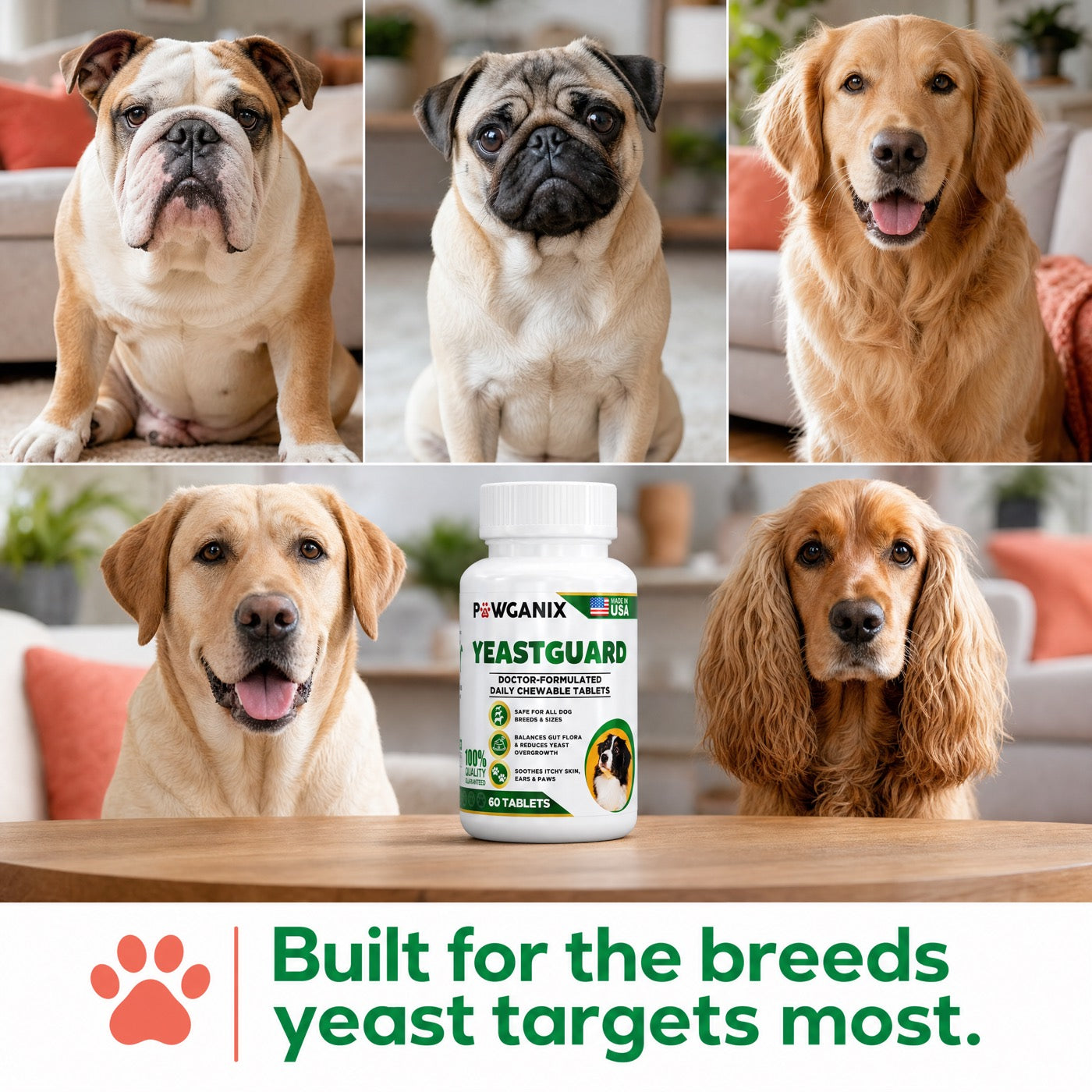
Look across all six and the surface stories are different, but the deeper pattern is the same: a skin and coat environment that leans yeast-friendly, kept off balance from the inside. That's why YeastGuard is built as a daily, 12-active, inside-out formula rather than another wipe or wash — supporting the gut (the foundation of the gut-to-skin axis), normal yeast balance, and a resilient, comfortable skin and coat microenvironment.
Because every dose is set by your dog's weight, the same bottle is right for a 16-lb Westie, a 30-lb Cocker, and an 80-lb Shepherd — it isn't a breed-specific product, it's a whole-dog balance product formulated with yeast-prone breeds like these in mind. Vet-reviewed, made for daily use, and backed by a 60-day happiness guarantee, so trying it for your breed is genuinely low-risk.
Pick your plan

Your free Welcome Bundle
Emailed the moment you check out — with every first order, subscribe or one-time.
- 📘The 60-Day Yeast Reset Guide — what to expect week by week
- 🥣Gut-Health Feeding Handbook — foods that help vs. feed yeast
- 📈Itch & Symptom Tracker — see the turnaround on paper
- 🦺Vet Q&A with Dr. Gaby Thompson, DVM
Tell Me About:
“Here's what nobody tells you about the paw-licking — it's rarely just the paws. When a dog's gut and skin fall out of balance, the itch shows up at the far end: feet, ears, belly. YeastGuard works the whole system at once — it supports the gut, promotes a normal yeast balance, and helps calm the skin from the inside out.”

✓ = included at a real, disclosed dose. “Big Pet Brands” = big-box brands that hide actives inside undisclosed “proprietary blends.” We print every dose on the label.
Puppies under 10 lb: 1 tablet daily. 60 tablets per bottle.
- ✓Less obsessive paw-licking & chewing
- ✓Calmer skin — less redness & irritation
- ✓Fresher ears — less odor & head-shaking
- ✓Supports a normal yeast balance
- ✓Gut-first support (the gut–skin connection)
- ✓Healthier skin & coat over the 30 to 60 day arc
It’s yeast, not allergy: the 5 clues your dog’s “allergies” were misdiagnosed

Your Welcome Bundle: five digital extras, free
Every first-time YeastGuard order gets these instantly by email after checkout:
- Yeast-Free Diet Blueprint (PDF): 42-page guide with a 14-day transition plan ($19.99)
- Ear Cleaning 101: vet-demonstrated video tutorial ($9.99)
- Starter Dosage Guide: dosing by your dog’s weight ($4.99)
- 8-Week Recovery Tracker: printable progress journal ($5.99)
- Summer Yeast Prevention Guide: seasonal flare-up playbook ($9.99)
All five are digital and delivered by email after checkout, included free with your first order at no extra cost.
The full 12. Nothing hidden.
Every active is printed right on the label at its own amount, in milligrams. No invented numbers, no hidden 'complexes.' Here's the full 12, and what each one is there for.
YeastGuard vs. surface-only care for yeast-prone breeds
This compares YeastGuard's daily inside-out support with typical surface-care products. It is not a comparison to, or a substitute for, prescription veterinary medicine — for anything your vet has diagnosed, follow their guidance.
The 60-Day Money-Back Guarantee
Your breed didn't choose its folds, its floppy ears, or its coat — and you shouldn't have to gamble on what supports them. Give YeastGuard a fair daily run, and if you're not seeing a calmer, more comfortable dog, tell us any time between day 30 and day 60 after delivery for a full refund. You keep the bottle, even if it's empty. No restocking fee. Balance is built gradually, so the window is long enough to actually judge it on your dog.
Questions, answered
🎥 PAWGANIX CREATORS · EARN IT BACK
Film your dog with YeastGuard.
Get the next one free.
Post it publicly and tag @pawganix on Instagram, Facebook or TikTok, and we send you a free bottle. Every approved video earns it, whether five people watch or fifty thousand. If it takes off, you earn cash on top.
Show your dog with YeastGuard. Post it public, tag @pawganix, add #ad #PawganixPartner.
Fill in the claim form with your public post link and your order number. It takes a minute.
A person checks the post and your bottle goes out. Send the link again if the video keeps climbing.
You receive a reward for posting, so the post must say so: #ad #PawganixPartner. Share what you see (“less scratching,” “more playful”), and please make no medical claims. Cash is the highest tier your video reaches within 60 days of posting. One reward per order, up to three per quarter. Full programme terms.
Formulated with yeast-prone breeds in mind.
Folds, floppy ears, water-loving coats, allergy-prone skin — your dog was born with the build. Support the balance behind it from the inside out, dosed by weight, backed by the 60-day happiness guarantee.
Shop Now