


German Shepherd Growth Chart: Weight and Height by Age
Listen to this article
Audio8 min listen · Prefer to hear it? Press play and keep browsing.
A male German Shepherd usually weighs about 49 to 57 pounds at 6 months and 70 to 75 pounds at 1 year. A female usually weighs about 44 to 49 pounds at 6 months and 60 to 64 pounds at 1 year. Adult males typically reach 65 to 90 pounds and 24 to 26 inches, and females 50 to 70 pounds and 22 to 24 inches. Most height arrives in the first year, but the body keeps filling out for about 2 years or more. Treat the chart as a range, not a target. Pawganix MoveGuard Growth supports joint development during the growth window, alongside vet care.
Joint support built for the growth window.
Shop MoveGuard Growth- How big do German Shepherds get?
- Male German Shepherd growth chart
- Female German Shepherd growth chart
- When do German Shepherds stop growing?
- Is my German Shepherd puppy on track?
- Why growth speed and weight matter for German Shepherd joints
- Supporting joints through the growth window
- When to call the vet
- Frequently asked questions
How big do German Shepherds get?
Adult males typically weigh 65 to 90 pounds, and adult females 50 to 70 pounds.
PetMD lists adult males at 65 to 90 pounds and 24 to 26 inches tall, and adult females at 50 to 70 pounds and 22 to 24 inches. Across the breed, that is a typical range of 50 to 90 pounds and 22 to 26 inches. Males are larger than females in both height and weight, and the two charts below reflect that.
Every puppy is an individual. Parents, lines and build all move a dog within, or occasionally outside, these ranges, which is why the numbers below are best read as a corridor and not a finish line.
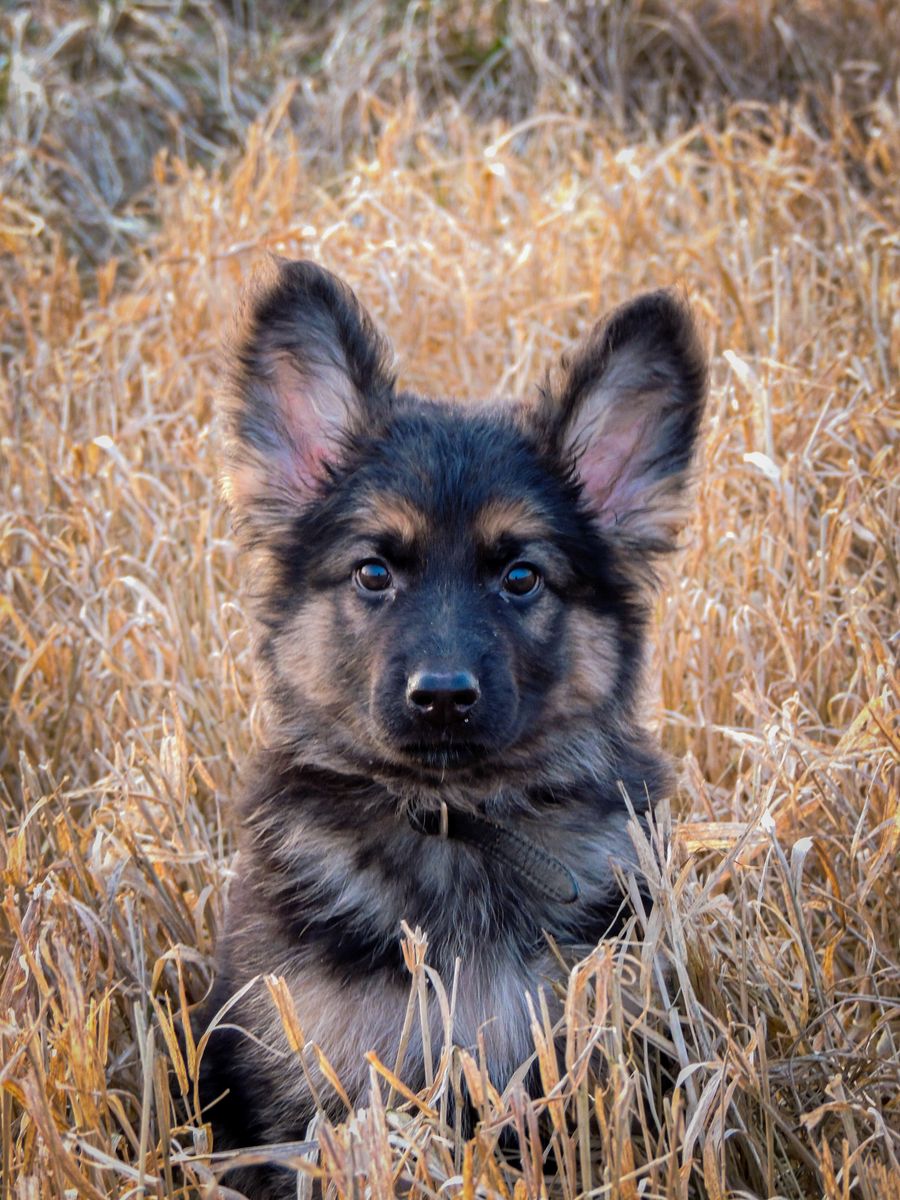
Photo: Pexels
Male German Shepherd growth chart
| Age | Typical weight | Typical height |
|---|---|---|
| 2 months | 16 to 20 lb | 7 to 9 in |
| 3 months | 22 to 30 lb | 9 to 11 in |
| 4 months | 35 to 40 lb | 11 to 14 in |
| 5 months | 40 to 49 lb | 14 to 16 in |
| 6 months | 49 to 57 lb | 16 to 18 in |
| 8 months | 62 to 66 lb | 20 to 22 in |
| 10 months | 66 to 73 lb | 22 to 24 in |
| 1 year | 70 to 75 lb | 22 to 24 in |
| 1.5 years | 70 to 79 lb | 23 to 25 in |
| 2 years | 70 to 85 lb | 23 to 25 in |
| 3 years | 70 to 90 lb | 24 to 26 in |
Typical ranges compiled by Hepper. Pounds (lb) and inches (in).
The biggest gains come early. A male roughly doubles his weight between 3 and 6 months, then slows. By 1 year he usually looks nearly full height, and the next year is mostly about filling out through the chest and body.
Female German Shepherd growth chart
| Age | Typical weight | Typical height |
|---|---|---|
| 2 months | 11 to 17 lb | 6 to 9 in |
| 3 months | 17 to 26 lb | 8 to 10 in |
| 4 months | 31 to 35 lb | 10 to 12 in |
| 5 months | 35 to 44 lb | 12 to 14 in |
| 6 months | 44 to 49 lb | 15 to 17 in |
| 8 months | 53 to 57 lb | 18 to 20 in |
| 10 months | 57 to 62 lb | 19 to 21 in |
| 1 year | 60 to 64 lb | 20 to 22 in |
| 1.5 years | 60 to 66 lb | 21 to 22 in |
| 2 years | 62 to 66 lb | 21 to 22 in |
| 3 years | 66 to 70 lb | 22 to 24 in |
Typical ranges compiled by Hepper. Pounds (lb) and inches (in).
Females follow the same pattern a little smaller and usually level off earlier. At 1 year the typical female is close to her adult weight range, while a male is often still adding weight.
When do German Shepherds stop growing?
Height mostly settles around the first birthday, while weight and body fill out for longer.
Sources describe the timing a little differently. Hepper says German Shepherds stop growing between 2 and 3 years, with females typically maturing faster than males. A large analysis of growth data from more than 6 million young dogs, published in PLOS ONE in 2017, noted that larger breeds can take up to 24 months to reach adult body weight, compared with 8 to 12 months for smaller breeds.
In practice, expect the fastest growth before about 8 months, a clear slowdown after the first year, and gradual filling out into the second year and beyond. A puppy that seems stuck, or one that suddenly jumps, is worth mentioning to your vet.
Is my German Shepherd puppy on track?
Weigh on a schedule
Weigh your puppy every two weeks on the same scale, at a similar time of day. A trend over several weeks tells you far more than a single number.
Compare to the range, not the midpoint
A puppy at the low or high end of the range can be perfectly healthy. Look for a smooth, steady climb rather than a perfect match.
Check the shape as well as the number
Ask your vet to show you how to judge body condition by feel and by looking down at your puppy from above. A lean, steady puppy is the goal.
Do not push for the top of the range
Faster is not better for a large breed. Feed measured amounts on your vet's advice and avoid free feeding.
Raise it early if something changes
A plateau, a sudden jump in weight, or a puppy that seems unwell should be seen by your vet.
Why growth speed and weight matter for German Shepherd joints
PetMD, citing the Canine Health Information Center, says about 20 percent of German Shepherds have hip dysplasia, a condition that can cause limping, reduced range of motion and pain, especially as arthritis develops later in life.
Extra weight makes every joint work harder. Cornell's Riney Canine Health Center names obesity as a significant contributor to osteoarthritis, because of the added force on the joints and the inflammatory signals that fat tissue produces. A steady, lean growth curve is one of the most useful things an owner controls.
For more on this stage, see our guides on German Shepherd puppy joint development, growth plates in puppies and hip dysplasia prevention.
How are your dog's joints really doing?
Take the free Joint & Mobility Clock. Ten quick questions about your dog, and you get a named stage, the four things loading your dog's joints, and a plan sized to your dog's weight. No email needed to see your result.
Take the Joint & Mobility Clock →Supporting joints through the growth window
The growth window is when a German Shepherd's joints and bones are still developing, and it only happens once. Lean growth, measured meals, sensible exercise and regular vet checks come first. Our large breed puppy growth guide and the broader puppy growth chart analysis cover the basics.
MoveGuard Growth is a daily joint chew made for the growth stage. It is dosed by your dog's expected adult weight, so check the label, and your vet can help you estimate that number for your puppy. It supports joint development, works alongside your vet's plan and does not replace veterinary care. Check the label for allergens if your dog has sensitivities, since it contains shellfish, krill, fish and soy. Results vary from dog to dog.
When to call the vet
- Your puppy limps for more than a day or two, or the limp keeps coming back
- Your puppy struggles to rise or avoids stairs and play
- Growth stalls or your puppy loses weight
- Your puppy has a swollen belly, keeps retching without producing anything, or seems restless and in distress. Bloat is a life-threatening emergency in deep-chested breeds
A growth chart cannot tell you if your puppy is healthy. Only an exam can, and regular weigh-ins at the vet are a good habit through the first two years.
A creator on supporting a growing pup
Support the Growth Window.
MoveGuard Growth is a daily joint chew made for large and giant breed puppies, dosed by expected adult weight. Every active is listed on the label.
Shop MoveGuard GrowthFrequently Asked Questions
A male typically weighs about 49 to 57 pounds and a female about 44 to 49 pounds at 6 months, according to Hepper's typical ranges. Individual puppies vary.
A male is typically about 70 to 75 pounds and 22 to 24 inches. A female is typically about 60 to 64 pounds and 20 to 22 inches.
Typically about 22 to 30 pounds for a male and 17 to 26 pounds for a female.
Height mostly settles around 1 year, while weight and body fill out for longer. Hepper puts the end of growth between 2 and 3 years, and a 2017 PLOS ONE analysis notes larger breeds can take up to 24 months to reach adult weight.
PetMD lists adult males at 65 to 90 pounds and 24 to 26 inches, and adult females at 50 to 70 pounds and 22 to 24 inches.
Yes. Males are taller and heavier on average, and females typically level off earlier.
The chart shows typical ranges, not rules. Steady growth and a lean body matter more than hitting a number. Share your weigh-in trend with your vet if you are unsure.
Some owners give a daily joint supplement during the growth window. MoveGuard Growth is dosed by expected adult weight and works alongside vet care, not instead of it.
Their growth window only happens once.
The free Growth Blueprint covers the months that matter, the mistakes to avoid and what to ask your vet.
Get the Growth BlueprintEnter your email on the next page. You'll also get new findings as we publish them. Unsubscribe any time. See our Privacy Policy.
You're already making the content. Get paid for it.
Commission on your link, or a flat fee per post. Your call. A real person reads every application and replies within two working days.
Apply in two minutesSources
- Cosgrove N. German Shepherd Growth and Weight Chart. Hepper. January 5, 2026. articles.hepper.com
- Morrison BJ, reviewed by Coates J. German Shepherd Dog Breed Health, Care, and Training. PetMD. Updated August 11, 2026. petmd.com
- Salt C, Morris PJ, German AJ, et al. Growth standard charts for monitoring bodyweight in dogs of different sizes. PLOS ONE. 2017. journals.plos.org
- Cornell University College of Veterinary Medicine. Osteoarthritis. Riney Canine Health Center. vet.cornell.edu
- Pawganix. MoveGuard Growth product page and label. pawganix.com
These statements have not been evaluated by the Food and Drug Administration. This product is not intended to diagnose, treat, cure, or prevent any disease. This content is for informational purposes only and is not a substitute for professional veterinary advice. A dog that suddenly limps, yelps, cannot get up, or shows swelling or heat in a joint should be seen by a vet. Pawganix supplements support joint comfort and mobility and work alongside veterinary care, not instead of it.
Where is your dog on the joint clock?
Ten questions about your dog. You get a named stage, the four things loading your dog's joints, a 30-day check-in date, and a plan sized to your dog's weight.
- 1Your dog's joint stage, named and scored
- 2The four things loading the joints
- 3A plan sized to your dog's weight, or a plain answer if no formula fits
Most read
-
 Puppy GrowthGerman Shepherd Hip Dysplasia Prevention18 min read
-
 Puppy GrowthGerman Shepherd Puppy Joint Development: What to Do From 8 Weeks to 18 Months8 min read
-
 Puppy GrowthLab and Golden Retriever Growth Plate Window (2026)14 min read
-
 Itch & YeastThe 7 Best Dog Yeast Infection Supplements Compared (2026 Review)14 min read
-
 Itch & YeastBest Supplements for French Bulldogs: What Actually Helps (And What's a Waste of Money)9 min read
-
 Itch & YeastBest Ear Infection Supplements for Dogs11 min read


