


How Much Exercise Is Safe for Large Breed Puppies (2026)
Listen to this article
AudioPrefer to hear it? Press play and keep browsing.
A common guideline, cited by the American Kennel Club, is about 5 minutes of walking per month of age, once or twice a day. Large breed puppies should wait on running and jogging until they mature, roughly 12 to 18 months for large breeds and 18 to 24 months for giant breeds. Until then, favor walks, play and training, and limit repeated jumping and hard-surface running. Pawganix MoveGuard Growth is a daily soft chew made for large breed puppies.
Raising a large or giant breed puppy?
Shop MoveGuard GrowthLarge breed puppies have a lot of energy and a lot of growing to do. The question owners ask most is how much exercise is enough, and how much is too much. Here is what the American Kennel Club, VCA Animal Hospitals and PetMD say, in plain terms.
What is the 5 minutes per month of age guideline?
Walk about 5 minutes for every month of age, once or twice a day.
The AKC attributes this guideline to veterinary researchers and describes it as a starting point, depending on walking speed and time available. It applies to walks. Free play is different, and most puppies stop when they are tired. Your vet can adjust the plan for your puppy's breed and build.
How long should walks be at each age?
| Puppy's age | Walk length per outing |
|---|---|
| 2 months | About 10 minutes |
| 3 months | About 15 minutes |
| 4 months | About 20 minutes |
| 6 months | About 30 minutes |
| 9 months | About 45 minutes |
| 12 months | About 60 minutes |
Calculated from the guideline described by the AKC (Gewirtz, updated March 8, 2024). Once or twice a day.
What should you limit until your puppy matures?
Growth plates are areas of soft growing bone. VCA describes them as sensitive and open to injury from strenuous exercise, and the AKC says the soft plates on bones need time to harden. Both name these activities to hold off on or limit:
- Long jogs and long hikes, which VCA says to avoid until maturity
- Jumping hurdles and competitive agility, per VCA
- Repeated jumping, such as tossing a ball straight up or dock diving, per the AKC
- Running or jogging on hard surfaces such as sidewalks and blacktop, per the AKC
- Leashed running, because a tethered puppy cannot stop when tired, per the AKC
Should you limit free play?
VCA says puppies should be allowed to run and play as they want, and the AKC says to let puppies set their own pace and rest when tired. Walks, play and leash training are all encouraged. Short training sessions and puzzle toys can tire a puppy mentally without adding load on the joints.
Is your puppy's growth on track?
Take the free Joint & Mobility Clock. Ten quick questions about your dog, and you get a named stage, the four things loading your dog's joints, and a plan sized to your dog's weight. No email needed to see your result.
Take the Joint & Mobility Clock →When can a large breed puppy start running?
The AKC suggests waiting until about 12 to 18 months for large breeds and 18 to 24 months for giant breeds.
VCA says giant breeds may need to wait closer to a year and a half before long jogs, hikes, hurdles or agility. PetMD says large breeds (59 to 99 pounds) reach full size at about 15 to 18 months and giant breeds (over 100 pounds) at 18 to 24 months, and that the best way to tell when a dog is fully grown is to check the growth plates with an X-ray. Your vet can tell you when your puppy is ready, and building up gradually is sensible when you start.
What signs mean you should slow down?
Tiring early
The AKC lists sitting down or struggling to keep up as signs of fatigue. Stop and let your puppy rest.
Limping or an odd gait
VCA advises contacting your vet if you notice limping or other issues with how your puppy walks, sits or moves.
Reluctance to go out
A puppy who usually loves walks but hangs back may need a lighter day.
Stiffness after rest
Stiffness when getting up after a big day is worth mentioning to your vet if it keeps happening.
- Your puppy limps for more than a day, or cannot put weight on a leg
- You see swelling near a joint
- Your puppy's gait changes suddenly or they refuse to move
For more on growing bones, see our guides on growth plates in puppies and panosteitis and growing pains.
What daily support is made for large breed puppies?
Pawganix MoveGuard Growth is a chicken-liver flavored soft chew for large and giant breed puppies, dosed by your puppy's expected adult weight. The label lists New Zealand green-lipped mussel, glucosamine, chondroitin, MSM, Antarctic krill oil, hyaluronic acid, vitamins C and E and manganese. It lists shellfish, krill, fish and soy as allergens. It is made in the USA and vet reviewed by Dr. Gaby Thompson, DVM. Check the label for your puppy's expected adult weight.
A Daily Joint Chew for Growing Large Breeds.
MoveGuard Growth is a daily soft chew joint formula for large and giant breed puppies, dosed by expected adult weight, with every active listed on the label.
Shop MoveGuard GrowthFrequently Asked Questions
The AKC cites a guideline of about 5 minutes of walking per month of age, once or twice a day, plus free play and training. Your vet can adjust this for your puppy.
Wait until your puppy matures. The AKC suggests about 12 to 18 months for large breeds and 18 to 24 months for giant breeds, and VCA says long jogs should wait until maturity. Ask your vet when your puppy is ready.
Occasional use is part of normal life. The AKC advises limiting repeated jumping, and VCA names jumping hurdles and agility as activities to hold off on until maturity.
VCA says puppies should be allowed to run and play as they want, and the AKC says to let puppies set their own pace and rest when tired. If your puppy limps or tires quickly, stop and ask your vet.
PetMD says large breeds (59 to 99 pounds) reach full size at about 15 to 18 months, and giant breeds (over 100 pounds) at 18 to 24 months. The best way to tell is an X-ray of the growth plates.
Short training sessions, puzzle feeders and sniff walks use mental energy without adding joint load. Rest and sleep matter as much as activity.
MoveGuard Growth is a daily soft chew joint formula for large and giant breed puppies, dosed by expected adult weight. The label lists green-lipped mussel, glucosamine, chondroitin, MSM, krill oil, hyaluronic acid, vitamins C and E and manganese.
You're already making the content. Get paid for it.
Commission on your link, or a flat fee per post. Your call. A real person reads every application and replies within two working days.
Apply in two minutesSources
- Gewirtz EW. How much mental and physical exercise do puppies need? American Kennel Club, updated March 8, 2024. akc.org
- VCA Animal Hospitals. Growth plates and exercise in puppies. vcahospitals.com
- Mitchell SC. When do dogs stop growing? PetMD, May 20, 2025. petmd.com
- Pawganix. MoveGuard Growth product page and label. pawganix.com
These statements have not been evaluated by the Food and Drug Administration. This product is not intended to diagnose, treat, cure, or prevent any disease. This content is for informational purposes only and is not a substitute for professional veterinary advice. Exercise needs vary by breed and individual puppy, so ask your veterinarian about the right plan for yours.
Where is your dog on the joint clock?
Ten questions about your dog. You get a named stage, the four things loading your dog's joints, a 30-day check-in date, and a plan sized to your dog's weight.
- 1Your dog's joint stage, named and scored
- 2The four things loading the joints
- 3A plan sized to your dog's weight, or a plain answer if no formula fits
Most read
-
 Puppy GrowthGerman Shepherd Hip Dysplasia Prevention18 min read
-
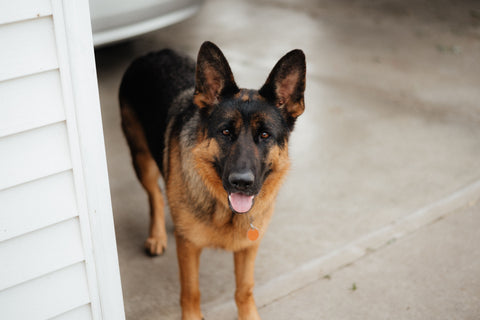 Puppy GrowthGerman Shepherd Puppy Joint Development: What to Do From 8 Weeks to 18 Months8 min read
-
 Puppy GrowthLab and Golden Retriever Growth Plate Window (2026)14 min read
-
 Itch & YeastThe 7 Best Dog Yeast Infection Supplements Compared (2026 Review)14 min read
-
 Itch & YeastBest Supplements for French Bulldogs: What Actually Helps (And What's a Waste of Money)9 min read
-
 Itch & YeastBest Ear Infection Supplements for Dogs11 min read


