


Dog Licking Paws in Fall: Allergies or Yeast?
Paw licking often climbs in fall because pollen, mold and damp leaf litter stick to paws, and wet paws stay warm and moist. That overlaps with food reactions and yeast overgrowth, so it is hard to tell the cause by looking. Rinse and dry paws after walks, track the pattern, and see your vet if licking is constant or the skin looks red. Pawganix YeastGuard supports gut and skin balance from the inside.
Support skin balance from the inside this season.
Shop YeastGuardWhy paw licking spikes in fall
Fall stacks several triggers into the same few weeks.
Pollens and molds are among the most common triggers for dogs with environmental allergies, and damp fallen leaves can hold plenty of mold. Grass is wet, and walks bring all of it back indoors on the paws. Licking or chewing the paws is one of the classic signs of environmental allergy, and veterinary sources note that signs are usually seasonal but can continue all year. Cornell's veterinary college reports a seasonal component in roughly 40 to 75 percent of atopic dogs.
The tricky part is that licking keeps the paws wet. Wet, warm skin between the toes is a good place for normal yeast to overgrow, so a seasonal allergy flare can turn into a yeast issue that outlasts the season.
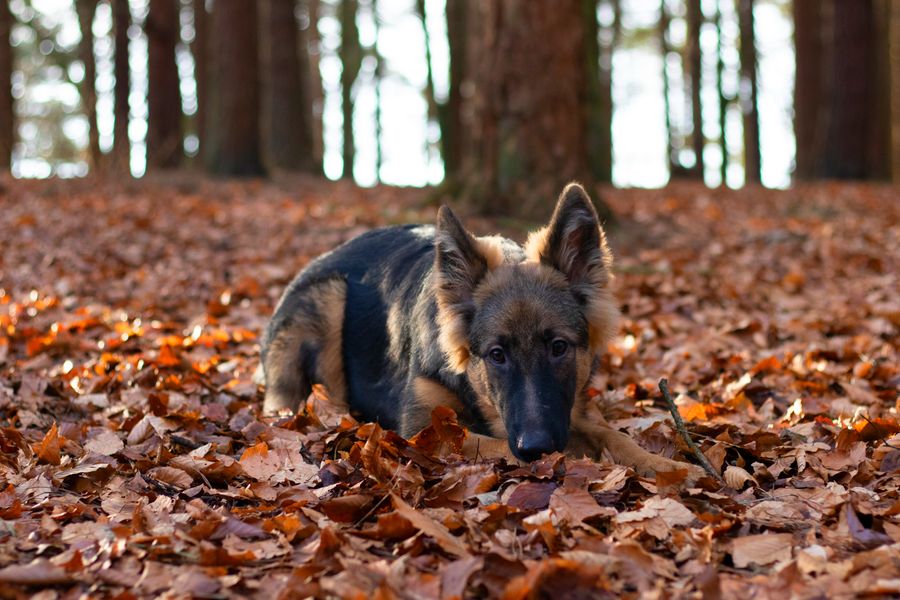
Photo: Pexels
Allergies or yeast: what the pattern tells you
You cannot sort this out from the paws alone, but patterns help you and your vet:
- Comes and goes with the season and eases after a rinse: points toward environmental triggers.
- Musty or corn chip smell, rust-colored staining or greasy skin between the toes: often mentioned with yeast overgrowth.
- Year-round licking with ear trouble or belly issues: worth discussing food and gut health with your vet.
- Licking limited to one paw: look for a splinter, cut, burr or pain first.
Many dogs have more than one thing going on. Our article on whether a dog's yeast issue is actually allergies goes through how the two overlap.
A 5-minute after-walk routine
Rinse or wipe the paws
Plain lukewarm water or an unscented wipe removes pollen and mold spores. Get between the toes and around the dewclaw.
Dry thoroughly
Use a towel and press between each toe. Damp skin is the part that matters, so finish dry.
Check the skin
Look for redness, staining, sores or an odd smell. Take a phone photo weekly so you can see change over time.
Wipe the belly and chest
Pollen settles on the coat too. A quick damp cloth over the underside helps reduce what gets licked off later.
What does not help
Soaking paws in strong solutions, using human creams, or applying anything your vet has not approved can irritate skin that is already inflamed. Cone collars and boots can stop the licking while you sort out the cause, but they do not address it.
The same goes for medicated shampoo used as the only step. Our piece on why shampoo alone does not fix dog yeast problems explains why the inside matters too.
What is behind your dog's paw licking?
Take the free Itch Loop Diagnostic. Ten quick questions about your dog, and you get the itch pattern named, the four things driving it, and a plan sized to your dog's weight. No email needed to see your result.
Take the Itch Loop →Supporting skin balance from the inside
If your vet has ruled out urgent causes and yeast overgrowth is on the table, a daily supplement can sit alongside the routine above. YeastGuard is a chicken-liver chewable with four named probiotic strains (4 billion CFU at time of manufacture), a 125mg prebiotic blend, sodium caprylate and botanical ingredients, each individually dosed on the label.
It supports gut and skin balance. It is not a treatment for allergies, and it does not replace allergy testing, medication or vet advice. Dosing is by weight, so check the label for your dog's weight. Some owners report changes within a few weeks, but results vary.
When to book the vet
- The skin is red, swollen, cracked or weeping
- Your dog limps or will not let you touch the paw
- Licking is constant, or wakes your dog at night
- The smell is strong or the problem returns every few weeks
A vet can check what is on the skin, rule out pain and parasites, and talk through allergy options. Bring photos and notes on when it started.
A creator on paw licking and scratching
Rinse the Paws. Support the Skin Inside.
Four named probiotic strains at 4 Billion CFU, a 125mg prebiotic blend, and botanical ingredients including caprylic acid and oregano extract. Every active individually dosed on the label.
Shop YeastGuardFrequently Asked Questions
Pollen, mold and damp leaves collect on paws, and wet paws stay warm and moist. That can trigger licking and, in some dogs, a yeast flare that lingers after the season ends.
Yes. Pollens and molds are common triggers, and damp fall leaves can hold mold. Signs are often seasonal, but they can continue year-round. Your vet can help work out whether environmental allergies are involved.
It is hard to tell without a vet check. A musty smell, rust staining or greasy skin points toward yeast, while a clear seasonal pattern suggests environmental triggers. Many dogs have both.
A rinse or wipe and thorough drying after walks through wet grass or leaves is a good habit for itchy dogs. Skip harsh soaps and strong solutions unless your vet recommends them.
A gut-focused daily routine can be part of the picture. YeastGuard combines probiotics, prebiotics and botanicals in a chewable dosed by weight. It works alongside vet care, not instead of it.
Stay one step ahead of the itch.
The free Yeast Complete Guide covers what drives the cycle, what actually breaks it, and the mistakes that keep it coming back.
Get the Yeast GuideEnter your email on the next page. You'll also get new findings as we publish them. Unsubscribe any time. See our Privacy Policy.
You're already making the content. Get paid for it.
Commission on your link, or a flat fee per post. Your call. A real person reads every application and replies within two working days.
Apply in two minutesSources
- Cornell University College of Veterinary Medicine, Riney Canine Health Center. Atopic dermatitis (atopy). vet.cornell.edu
- Merck Veterinary Manual, Dog Owners edition. Allergies in Dogs. merckvetmanual.com
- Bajwa J. Canine Malassezia dermatitis. Canadian Veterinary Journal. 2017;58(10). pmc.ncbi.nlm.nih.gov
- Pawganix. YeastGuard product page and label. pawganix.com
These statements have not been evaluated by the Food and Drug Administration. This product is not intended to diagnose, treat, cure, or prevent any disease. This content is for informational purposes only and is not a substitute for professional veterinary advice. Sore, red or weeping skin, a head tilt, a bad smell from the ears, or a dog that seems in pain should be seen by your vet. YeastGuard is a daily supplement that works alongside veterinary care, not instead of it.
What is behind the itch?
Ten questions about your dog. You get the itch pattern named and scored, the four things driving it, a date for the first visible change, and a 60 day pack sized to your dog's weight.
- 1Your dog's itch pattern, named and scored
- 2The four drivers behind it
- 3A 60 day pack sized to your dog's weight
Most read
-
 Itch & YeastThe 7 Best Dog Yeast Infection Supplements Compared (2026 Review)14 min read
-
 Itch & YeastBest Supplements for French Bulldogs: What Actually Helps (And What's a Waste of Money)9 min read
-
 Itch & YeastBest Ear Infection Supplements for Dogs11 min read
-
 Itch & YeastYeastGuard vs. Zesty Paws Aller-Immune Bites: Ingredients, Results, and Value Compared10 min read
-
 Itch & YeastDog Itching But No Fleas: 8 Other Causes You Need to Check11 min read
-
 Itch & YeastChronic Dog Ear Yeast Infection: Home Treatment That Actually Stops the Cycle14 min read


