


Senior Cat Health: What Changes After 10
That means the vast majority of senior cats are living with joint changes — and the vast majority of their owners have no idea. The reason is that cats hide pain. They do not limp the way dogs do. They do not whine, cry, or hold up a sore leg. Instead, they make subtle behavioral adjustments: jumping less, sleeping more, choosing lower resting spots, grooming less (because twisting to groom hurts), or becoming irritable when touched in certain areas.
These changes happen gradually, over months or years, and owners attribute them to "just getting older" rather than to a treatable condition. This article explains why cat arthritis is so common, how to recognize the signs your vet might miss, and what interventions actually help.
Why Cat Arthritis Is Massively Underdiagnosed
Cats Hide Pain
This is an evolutionary survival strategy. In the wild, showing weakness attracts predators. Domestic cats retain this instinct — they mask pain and disability until it is severe. By the time a cat is visibly limping, the joint disease is advanced.
Vets Do Not Always Screen for It
Unlike dogs, where arthritis screening is routine for senior patients, cat arthritis is not consistently evaluated during wellness exams. Cats are notoriously difficult to examine orthopedically (they tense during handling), and radiographs are not always recommended during routine senior checkups.
The Signs Are Behavioral, Not Physical
A dog who stops climbing stairs is immediately recognized as having a mobility issue. A cat who stops jumping onto the bed is assumed to have changed preferences. The behavior change is the same — pain avoidance — but the interpretation is different.
Signs of Arthritis in Cats (Most Owners Miss These)
- Reluctance to jump: No longer jumping onto counters, beds, or cat trees that the cat previously accessed easily. Jumping down instead of up (landing is less painful than launching).
- Reduced jump height: Choosing lower perches. Using intermediate surfaces (chair → desk → shelf) instead of a single jump.
- Stiffness after rest: Moving slowly or awkwardly after sleeping. The first few steps after getting up are hesitant.
- Decreased grooming: Matted fur, dandruff, or an unkempt coat — particularly on the lower back and hind legs, the areas hardest to reach when joints are sore.
- Increased grooming of specific joints: Licking or biting at the hips, knees, or elbows — the cat is trying to soothe the pain.
- Litter box avoidance: If the litter box has high sides or requires stepping up, the arthritic cat may avoid it because entry is painful. Often misdiagnosed as a behavioral issue.
- Irritability when touched: A previously friendly cat who hisses, swats, or moves away when you touch their back, hips, or legs.
- Reduced activity and play: Less interest in toys, less running, less climbing. Often attributed to aging but actually pain avoidance.
- Sleeping more: Pain is exhausting. Cats with arthritis may sleep 18–20 hours per day instead of the normal 12–16.
Which Joints Are Most Commonly Affected
Feline arthritis most commonly affects the elbows, hips, stifles (knees), hocks (ankles), and spine — particularly the lumbosacral junction at the base of the spine. Spinal arthritis is especially common in cats and causes the stiffness, reluctance to jump, and grooming changes described above.
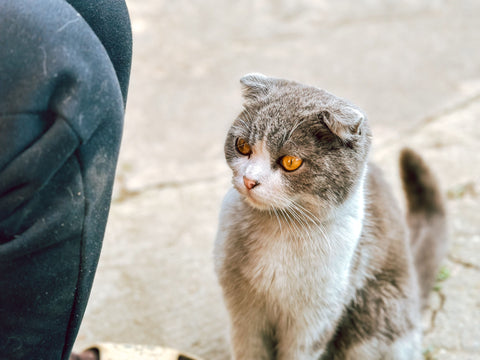
Unlike dogs, where hip and elbow dysplasia are the primary drivers of early arthritis, cat arthritis is more commonly age-related degeneration without a specific developmental precursor. Certain breeds — Maine Coons, Scottish Folds, and Persians — have higher rates due to breed-specific joint and bone characteristics.
Cat Joint Support Is Coming
Pawganix is developing feline-specific joint health products. Visit the Cat Wellness Hub for updates.
Visit the Cat Wellness Hub →What Actually Helps: The Four Interventions
Environmental Modification (Immediate Impact)
The single most effective intervention for arthritic cats is making their environment easier to navigate. Provide ramps or steps to high surfaces (beds, couches, cat trees). Switch to a low-entry litter box — cut a U-shaped entry into the side for step-in access. Place food, water, and litter on the same floor as the cat's primary living area. Provide heated beds (warmth soothes arthritic joints). Place non-slip rugs on slippery floors. These changes cost little and take effect immediately.
Weight Management
Every excess pound a cat carries increases mechanical load on arthritic joints. For overweight cats, achieving ideal body weight is one of the most impactful pain-management interventions. A 2-pound weight loss in a 14-pound cat reduces joint loading by approximately 14 percent — the equivalent effect of a moderate dose of pain medication, without the side effects.
Joint Support Supplementation
Feline joint supplements containing glucosamine, chondroitin, and omega-3 fatty acids (EPA/DHA) can provide cartilage support and anti-inflammatory benefit. Green-lipped mussel extract has some feline-specific evidence for joint comfort. Omega-3 supplementation (fish oil at feline-appropriate doses) has the strongest evidence for anti-inflammatory joint support in cats. The evidence base for feline joint supplements is growing, though not yet as extensive as the canine literature.
Veterinary Pain Management
For moderate to severe arthritis, prescription pain management may be needed. Solensia (frunevetmab) is a monthly injection approved specifically for feline osteoarthritis pain — a monoclonal antibody targeting nerve growth factor (NGF) that provides significant pain relief without the GI side effects of traditional NSAIDs. Meloxicam at cat-safe doses may be prescribed for short-term use. Gabapentin provides chronic pain modulation. Feline pain management has advanced dramatically in recent years — discuss current options with your vet.
Senior Cat Health Guide: What Changes After Age 10 →
Frequently Asked Questions
Arthritis cannot be reversed — the cartilage damage that has occurred is permanent. But it can be managed effectively through environmental modification, weight management, joint support, and pain medication when needed. The goal is comfort and mobility preservation, not cure. Most arthritic cats on a comprehensive management plan maintain good quality of life for years.
Radiographic changes begin appearing as early as age 6 in some cats, though clinical signs typically become noticeable after age 10. For proactive owners, starting omega-3 supplementation (the gentlest joint support intervention) at age 7 to 8 is reasonable. Environmental modifications (ramps, low-entry litter boxes) cost nothing and can be implemented at any age.
Not necessarily. Cats with mild to moderate arthritis may still jump — but they may jump less frequently, hesitate before jumping, or choose lower targets. The absence of a complete inability to jump does not rule out joint pain. Watch for changes in jumping behavior over time rather than a complete inability to jump as your benchmark.
Supporting Senior Cats Through Every System
From gut health to joint comfort to anxiety management — the Cat Wellness Hub has evidence-based guidance for every challenge.
Visit the Cat Wellness Hub →Most read
-
 CatsMulti-Cat Household Stress: Why Your Cats Fight and How Pheromones Can Help8 min read
-
 CatsCat Vomiting: Hairballs or Gut Problem?6 min read
-
 CatsSeparation Anxiety in Cats7 min read
-
 CatsCat Calming Collars, Diffusers & Sprays7 min read
-
 CatsFeliway vs Pawganix: Cat Calming Compared7 min read
-
 CatsCat Anxiety: The Complete Guide to Causes, Symptoms, and Solutions9 min read


