


Joint Supplement Guide, Large Breed Puppies
- What Is a Joint Supplement for Large Breed Puppies?
- Why Large Breeds Need Targeted Support
- The Critical Growth Window: 8–30 Months
- Breeds at Highest Risk
- What to Look For in 2026
- Key Ingredients and What Each Does
- Red Flags: What to Avoid
- When to Start
- Why MoveGuard Growth Was Built for This Window
- Frequently Asked Questions
What Is a Joint Supplement for Large Breed Puppies?
A joint supplement for large breed puppies is a daily chew or powder designed to support cartilage development, reduce inflammation, and protect hips and elbows during the critical growth phase — typically from 8 weeks to 18 months. Large and giant breeds grow so rapidly that their joints are under constant stress, making targeted nutritional support a proactive part of responsible ownership rather than a reactive one.
If you own a Labrador Retriever, Golden Retriever, German Shepherd, Great Dane, or any other large or giant breed, you already know that these dogs are built differently. Their size is their defining characteristic — and it is also their greatest vulnerability. The same rapid growth that makes a Great Dane puppy spectacular at 12 weeks makes their hips, elbows, and cartilage deeply susceptible to damage if nutritional support is absent during development.
This guide covers what a large breed puppy joint supplement actually does, which ingredients matter, which breeds need it most, and what to look for — and avoid — when choosing one in 2026.
- Large breed puppies experience joint stress during rapid growth that small breeds never encounter
- Growth plates remain open until 18–20 months in large breeds and up to 30 months in giant breeds — this is the critical window
- The best supplements combine glucosamine, chondroitin, MSM, and New Zealand green-lipped mussel in fully disclosed, clinically meaningful doses
- Many products hide sub-therapeutic doses inside proprietary blends — dose transparency is non-negotiable
- Starting early (from 8 months) supports cartilage development during the growth phase, not just after damage has occurred
- MoveGuard Growth is vet-reviewed and specifically formulated for the 8–30 month large and giant breed growth window
Why Large Breeds Need Targeted Support
A Chihuahua and a Great Dane both grow from puppy to adult, but they do so at radically different speeds and under radically different mechanical loads. A large breed puppy can gain 2–3 pounds per week during peak growth phases. That weight is borne entirely by developing joints — hips, elbows, shoulders, and knees that are not yet fully formed and whose cartilage is still actively building.
The result is a paradox that many new large breed owners don't anticipate: the fastest-growing puppies are the most vulnerable puppies. Cartilage needs time and the right nutritional building blocks to develop correctly. When growth outpaces nutritional support, the risk of developmental orthopedic diseases — hip dysplasia, elbow dysplasia, osteochondrosis — rises significantly.
Joint damage that occurs during puppyhood tends to be cumulative and progressive. Supporting cartilage development during the growth phase is not about treating a problem — it is about ensuring the structure that forms is the best it can be, given the genetic blueprint your dog was born with.
This is fundamentally different from the adult dog joint supplement market, which is largely focused on managing existing stiffness or arthritis in older dogs. Large breed puppy joint supplements are formulated for a different biological purpose: building healthy joint architecture during development, not repairing damaged tissue after the fact.
The Critical Growth Window: 8–30 Months
The single most important fact for any large breed puppy owner to understand is this: growth plates close at different ages in different breeds, and until they close, your puppy's skeleton is not finished.
Growth is rapid and cartilage is at its most formative. This is the earliest point to begin nutritional support. Joints are building their foundational architecture.
Peak weight gain phase in most large breeds. Hips and elbows are under the greatest proportional load relative to cartilage maturity. Hip dysplasia risk factors are most active during this window.
Growth slows but the skeleton is still maturing. Growth plates in the femoral head and elbow remain open. Overexercise during this period is a known risk factor for joint damage.
Most large breeds approach skeletal maturity. Growth plates closing. Nutritional support during this phase supports the final stage of cartilage development.
Giant breeds (Great Dane, Bernese Mountain Dog, Irish Wolfhound, Mastiff) may not reach full skeletal maturity until 24–30 months. Supplementation remains relevant until plates are confirmed closed. MoveGuard Growth covers the full 8–30 month window for this reason.
Understanding this timeline changes how you think about a joint supplement for large breed puppies. It is not an optional add-on for dogs who are already showing signs of discomfort. It is a nutritional tool for the growth phase itself — the same way quality large breed puppy food is not optional, it is foundational.
Breeds at Highest Risk
Not all large breeds carry equal joint risk. The breeds below are most frequently associated with developmental orthopedic conditions and are the exact dogs whose owners should be prioritising joint supplement support from early in the growth window.
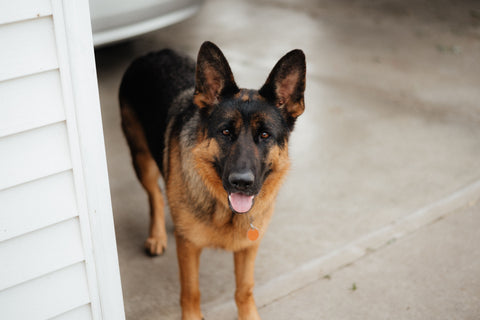
German Shepherd — Hip dysplasia is so prevalent that OFA screening is considered a baseline requirement for responsible breeders. Begin supplementation from 8 weeks.
Labrador Retriever — Elbow dysplasia and hip dysplasia are among the most common health concerns in Labs. A genetic predisposition combined with their active nature makes joint support essential during growth. See: Labrador Puppy Hip Health: Early Prevention.
Golden Retriever — Hip dysplasia is extremely common, and Goldens are also prone to cruciate ligament issues as adults — issues that often begin with joint architecture formed during puppyhood. See: Golden Retriever Puppy Growth and Joint Protection.
Great Dane — The fastest-growing of all giant breeds. Growth plate closure can take up to 30 months. Osteochondrosis is a significant risk without adequate nutritional support through the full growth window.
Rottweiler — Prone to both hip and elbow dysplasia. Rottweilers are powerful dogs whose joint development must keep pace with their substantial adult body mass.
Bernese Mountain Dog — A breed with a deeply loyal following and, unfortunately, a shortened lifespan partly attributable to orthopedic disease. Early joint support is considered standard practice among responsible Berner owners.
Mastiff / Bullmastiff — Sheer weight during the growth phase places enormous mechanical stress on developing joints. Giant breed-specific dosing is essential.
St. Bernard / Newfoundland — Working breeds whose joint health is foundational to their quality of life. Growth is prolonged and nutritional support should match the extended developmental window.
Not Sure Where to Start?
Take the free Joint & Mobility Clock. Ten quick questions about your dog, and you get a named stage, the four things loading your dog's joints, and a plan sized to your dog's weight. No email needed to see your result.
Take the Joint & Mobility Clock →What to Look For in a Joint Supplement in 2026
The pet supplement market is large and largely unregulated. A product that sits on the shelf next to a medically sound formulation may contain a fraction of the active ingredient dose — or ingredients with no evidence base at all. Knowing what to look for is the most important skill you can develop as a large breed puppy owner.
1. Full Dose Transparency — Every Milligram on the Label
Any reputable joint supplement will list the exact dose of each active ingredient per serving in its guaranteed analysis. If a product says it "contains glucosamine" inside a proprietary blend without specifying milligrams per serving, there is no way to assess whether the dose is therapeutic. This is non-negotiable in 2026.
2. Formulated for Growth — Not Adapted from an Adult Formula
Many joint supplements on the market are formulated for adult dogs managing arthritis or stiffness, then marketed to puppy owners. These products may not include the co-factors most important during the cartilage-building phase. Look explicitly for products built from scratch for the large breed growth window — like MoveGuard Growth, which is vet-reviewed and stage-specific.
3. New Zealand Green-Lipped Mussel as a Core Ingredient
NZ Green-Lipped Mussel is the one ingredient that separates serious large breed puppy formulas from basic glucosamine chews. It contains a unique class of omega-3 fatty acids (including ETA — eicosatetraenoic acid) not found in fish oil, and provides a natural spectrum of glycosaminoglycans that directly support developing joint tissue. It should appear in the formula with its dose disclosed.
4. A Multi-Ingredient Synergistic Formula
Single-ingredient products (glucosamine only) consistently underperform compared to multi-ingredient formulas where each component addresses a different aspect of joint development. The best large breed puppy supplements cover: structural support (glucosamine, chondroitin), anti-inflammatory support (MSM, green-lipped mussel, krill omega-3s), lubrication (hyaluronic acid), and tissue co-factors (vitamin C, manganese).
5. Real Palatability — Chicken Liver, Not Artificial Flavour
A supplement your puppy refuses to eat is worthless. Large breed puppy joint supplements require daily administration for 18–30 months to cover the full growth window. Real chicken liver as a flavour base (rather than artificial chicken flavour) produces significantly higher daily compliance — your puppy accepts it voluntarily, and it's gentle on the stomach.
6. Made in a GMP / NSF-Certified Facility
Third-party testing at a GMP (Good Manufacturing Practice) or NSF-certified facility verifies potency and purity. This matters because label claims and actual contents can diverge significantly in the unregulated supplement market. Certificates of Analysis on request is the baseline standard.
Key Ingredients and What Each Does
Below is what each active ingredient in a quality large breed puppy joint supplement is actually doing in your dog's body — based on the formula in MoveGuard Growth, with all doses disclosed per chew.
Glucosamine HCl — 400mg
The foundational structural ingredient. Glucosamine is a natural compound used by the body to produce glycosaminoglycans — the molecules that form the backbone of cartilage. During the growth phase, when cartilage is being actively built, a reliable supply of glucosamine supports the structural quality of developing tissue.
Chondroitin Sulfate (Bovine) — 300mg
Chondroitin works alongside glucosamine to inhibit the enzymes that break down cartilage. In a rapidly growing puppy, chondroitin helps protect newly-formed cartilage from premature degradation — particularly important in breeds gaining significant body mass weekly.
Green-Lipped Mussel (New Zealand) — 250mg
The hero ingredient. NZ green-lipped mussel contains ETA (eicosatetraenoic acid) — a unique omega-3 not found in fish oil — alongside a natural spectrum of glycosaminoglycans. It supports joint comfort, reduces inflammatory signalling in developing tissue, and provides building blocks that complement glucosamine and chondroitin. This is what distinguishes premium puppy joint formulas from basic glucosamine chews.
MSM (Methylsulfonylmethane) — 250mg
MSM is an organic sulphur compound that supports a balanced inflammatory response and helps maintain the collagen matrix in developing cartilage. In a growing dog whose joints are under daily mechanical stress, MSM provides anti-inflammatory nutritional support at the tissue level.
Antarctic Krill Oil — 150mg
Krill oil provides EPA and DHA omega-3 fatty acids in phospholipid form — a delivery format that research suggests offers superior bioavailability compared to standard fish oil triglycerides. Omega-3s in developing joint tissue support healthy inflammatory regulation during the growth window.
Vitamin C (Ascorbic Acid) — 50mg
Vitamin C is required for collagen synthesis. Collagen is the structural protein that gives cartilage, tendons, and ligaments their tensile strength. During the growth phase, when the body is producing large volumes of new connective tissue, vitamin C supports the quality of that tissue formation.
Hyaluronic Acid — 15mg
Hyaluronic acid is the primary component of synovial fluid — the lubricant inside every joint. As a puppy grows and joint spaces develop, adequate hyaluronic acid supports the lubrication of those spaces, reducing friction during movement and protecting maturing cartilage surfaces.
Vitamin E (D-Alpha Tocopherol) — 25 IU
Vitamin E is a fat-soluble antioxidant that protects developing joint tissue from oxidative damage — particularly relevant in high-growth phases where metabolic activity is elevated and tissue is most vulnerable.
Manganese (as Manganese Gluconate) — 2mg
Manganese is a trace mineral essential for the formation of glycosaminoglycans and connective tissue. Frequently omitted from lower-quality formulas, its role in cartilage matrix formation makes it a meaningful inclusion in a puppy-specific joint supplement.
Every dose above is printed directly on the MoveGuard Growth label — no proprietary blends, no hidden amounts. Knowing what your dog is getting per chew is how you make an evidence-based choice.
Red Flags: What to Avoid
A supplement for large breed puppies that relies on a single ingredient, hides doses in a "proprietary blend," contains artificial colours or flavours, or is clearly formulated for adult dogs managing chronic arthritis is not the right tool for the growth window.
- Proprietary blends without per-ingredient dosing — these frequently hide sub-therapeutic amounts of expensive ingredients
- Glucosamine alone, no chondroitin — the two work synergistically; single-ingredient formulas underperform
- No green-lipped mussel or marine omega-3 source — anti-inflammatory support is as important as structural support during development
- Artificial chicken flavour instead of real chicken liver — real palatability requires real ingredients; artificial flavours are a cost-cutting measure that harms compliance
- "Joint support for all life stages" labelling — this typically means the formula is not optimised for any stage in particular
- No vitamin C or manganese — these collagen and connective tissue co-factors are commonly omitted in budget formulas
- No GMP or NSF facility certification — without third-party testing, label claims cannot be verified
When to Start
The answer, for most large and giant breed puppies, is: as early as 8 months, when the frame is growing fast and the joints are still forming. This is not premature — it is the opening of the most critical phase of the growth window.
Starting early is a start-early choice, not a wait-and-see one. The growth window does not pause while you observe whether your puppy develops symptoms. By the time symptoms appear, the developmental period may already be compromised.
For breed-specific and age-specific timing guidance, see: How Early Should You Start a Joint Supplement for a Large Breed Puppy? and When to Start Joint Supplements for Large Breed Puppies.
Think of a large breed puppy joint supplement the way you think about puppy vaccinations or quality large breed puppy food: not a response to a problem, but a standard part of the developmental protocol for a dog whose biology demands it.
Why MoveGuard Growth Was Built for This Window
MoveGuard Growth was developed with one specific biological window in mind: the period from 8 to 30 months during which large and giant breed puppies are building the joint architecture they will carry for the rest of their lives.
It is vet-reviewed and stage-specific — built from scratch for the growth window, not adapted from an adult formula. Every ingredient is selected for what it contributes during active development. The 9 fully-disclosed actives — led by NZ Green-Lipped Mussel (250mg) and Antarctic Krill oil — address structural building, inflammatory regulation, lubrication, collagen synthesis, and connective tissue formation simultaneously.
The soft chew format uses real chicken liver, not artificial flavour. Dosed by expected adult weight (50–80 lb or 80–100+ lb). Free from wheat, corn, artificial colours, artificial flavours, and artificial preservatives. Made in a GMP/NSF facility in the USA. Backed by a 60-Day Guarantee.
Give Them the Start They Deserve
Vet-reviewed for the 8–30 month large and giant breed growth window. Every dose on the label. Real chicken-liver soft chews dogs look forward to.
MoveGuard Growth — joint supplement for large breed puppies →Frequently Asked Questions
If your dog is a large or giant breed still growing (roughly 8–30 months), choose MoveGuard Growth. If your dog is a grown adult (24+ months), medium or large breed, choose MoveGuard Adult. The comparison above breaks it down by age, size, and goal.
Many big-dog parents start daily joint support early in the growth window — an ideal starting point is around 8 months, when the frame is growing fast and the joints are still forming. It's a start-early choice, not a wait-and-see one.
Yes — that's the idea. Most dogs graduate from MoveGuard Growth to MoveGuard Adult around 24 months, once they're fully grown. Same brand, same transparency, calibrated for the new stage.
Both are real chicken-liver soft chews made to be easy to give every day. As with any new supplement, introduce it with food and consult your veterinarian, especially if your dog is on medication.
New Zealand Green-Lipped Mussel in both formulas, every dose printed on the label, vet-reviewed and stage-specific, made in a GMP/NSF facility in the USA, and backed by a 60-Day Guarantee.
Related Reading
- How Early Should You Start a Joint Supplement for a Large Breed Puppy?
- Large Breed Puppy Growth: Complete Guide to Joints and Bones
- Growth Plates in Puppies: Large Breed Owner Guide
- When to Start Joint Supplements for Large Breed Puppies
- Large Breed Puppy Nutrition: Why Getting It Wrong Damages Joints
- What Is Green-Lipped Mussel for Dogs? Benefits, Dosage and Science
- Do Large Breed Puppies Need Joint Supplements? What the Research Shows
- Best Joint Supplements for Large Breed Puppies
* These statements have not been evaluated by the Food and Drug Administration. This product is not intended to diagnose, treat, cure, or prevent any disease. Always consult your veterinarian before starting your dog on a new supplement, particularly if your dog is on medication or has an existing health condition.
Where is your dog on the joint clock?
Ten questions about your dog. You get a named stage, the four things loading your dog's joints, a 30-day check-in date, and a plan sized to your dog's weight.
- 1Your dog's joint stage, named and scored
- 2The four things loading the joints
- 3A plan sized to your dog's weight, or a plain answer if no formula fits
Most read
-
 Puppy GrowthGerman Shepherd Hip Dysplasia Prevention18 min read
-
 Puppy GrowthGerman Shepherd Puppy Joint Development: What to Do From 8 Weeks to 18 Months8 min read
-
 Puppy GrowthLab and Golden Retriever Growth Plate Window (2026)14 min read
-
 Itch & YeastThe 7 Best Dog Yeast Infection Supplements Compared (2026 Review)14 min read
-
 Itch & YeastBest Supplements for French Bulldogs: What Actually Helps (And What's a Waste of Money)9 min read
-
 Itch & YeastBest Ear Infection Supplements for Dogs11 min read


